Physical asset tokenization examples
Physical assets are the easiest category to picture: something you could touch, split into digital shares that can be bought, sold, and tracked on a blockchain.
Real estate
RealT tokenizes US rental properties and lets investors buy a share starting at $50. The company has tokenized apartment buildings in New York and San Francisco. Each property is split into digital tokens that represent fractional ownership. Investors get exposure to rental income without the capital or paperwork a full purchase requires.
For a closer look at vendors that build platforms like this, see Real estate tokenization companies and a real estate tokenization case study.
Art and collectibles
Sygnum Bank tokenized a share of a Picasso painting, the first time ownership rights to a Picasso were broadcast on a public blockchain by a regulated bank. The painting “Fillette au beret” was split into Art Security Tokens through Sygnum, a regulated Swiss bank. Investors could buy and trade a share of the artwork instead of the whole piece. Because a licensed bank issued the tokens, the offering carried standard custody and compliance protections.
Supply chain
Fishcoin tokenizes seafood products to give each one a traceable digital identity from catch to plate. The platform assigns a token-based identity to individual seafood products. Buyers and regulators can trace origin and handling at each step. This use case is a traceability tool first and an investment vehicle second.
Precious metals
Pax Gold (PAXG) turns physical gold into a tradable token, with each token backed by one troy ounce of gold. Every PAXG token is backed 1:1 by a troy ounce of London Good Delivery gold held in LBMA-accredited vaults. Independent auditors verify the reserves each month. Holders get the price exposure of gold without the cost of storing it physically.
Luxury goods
Hedonism Wines launched a tokenization platform in 2026 that links NFTs to individual bottles of rare wine and spirits. The London retailer issues one NFT per bottle, stored under controlled conditions. Token holders can hold, gift, transfer, or redeem the token for physical delivery. The same model works for any collectible where authenticity and provenance matter.
Digital and financial asset tokenization examples
Not every tokenized asset is physical. Currency, bonds, funds, and in-game items are tokenized just as often, sometimes at a much larger scale.
Cryptocurrency
Bitcoin is often called the first tokenized asset, since it represents value directly on a blockchain rather than a claim on something held elsewhere. Every other tokenized asset in this article represents an underlying thing. Bitcoin does not. That distinction matters when comparing tokenized securities to native crypto assets.
Bond
Siemens and the Hong Kong government have both issued tokenized bonds on public blockchains. Siemens issued a one-year digital bond on the Polygon blockchain. The Hong Kong government issued a $100 million tokenized green bond using Goldman Sachs’ GS DAP protocol. Both are large, regulated issuers using tokenized bonds for real settlement, not as a proof of concept.
In-game assets
Axie Infinity showed early on that game items could be tokenized, traded, and turned into real income for players. Players could own and sell in-game assets as tokens instead of licensed items locked inside the game. It was one of the first projects to prove tokenized digital ownership works outside finance. Newer gaming projects have refined the model, but Axie Infinity is still the reference case for the category.
Intangible assets
Tokenization also extends to intangible assets, such as intellectual property, patents, and trademarks. These assets can be digitized, fractionalized, and traded, unlocking new value streams for businesses.
Investment funds
BlackRock and Securitize launched a tokenized fund in 2024, and BlackRock has said it plans to tokenize far more of its assets over time. Securitize handled the tokenization infrastructure for the fund. BlackRock CEO Larry Fink has called tokenization the next generation for markets. A fund launch from the world’s largest asset manager signals that tokenized funds are moving into standard infrastructure, not staying a niche product.
Tokenized asset examples at a glance
| Asset class | Example | What it shows |
|---|---|---|
| Real estate | RealT | Fractional ownership starting at $50 |
| Art | Picasso, via Sygnum | Bank-issued shares in a single painting |
| Gold | Pax Gold (PAXG) | 1:1 backed, reserves audited monthly |
| Wine and spirits | Hedonism Wines | One NFT per bottle, redeemable for delivery |
| Seafood supply chain | Fishcoin | Traceable digital identity per product |
| Cryptocurrency | Bitcoin | Value native to the blockchain itself |
| Bonds | Siemens, Hong Kong government | Institutional-grade settlement |
| Investment funds | BlackRock and Securitize | Large-scale fund tokenization |
| Gaming | Axie Infinity | Player-owned, tradable |
Why asset tokenization projects fail
Three problems explain most tokenization projects that stall or fail after launch: low liquidity, unclear ownership, and heavy regulation. Each has already played out in a real project.
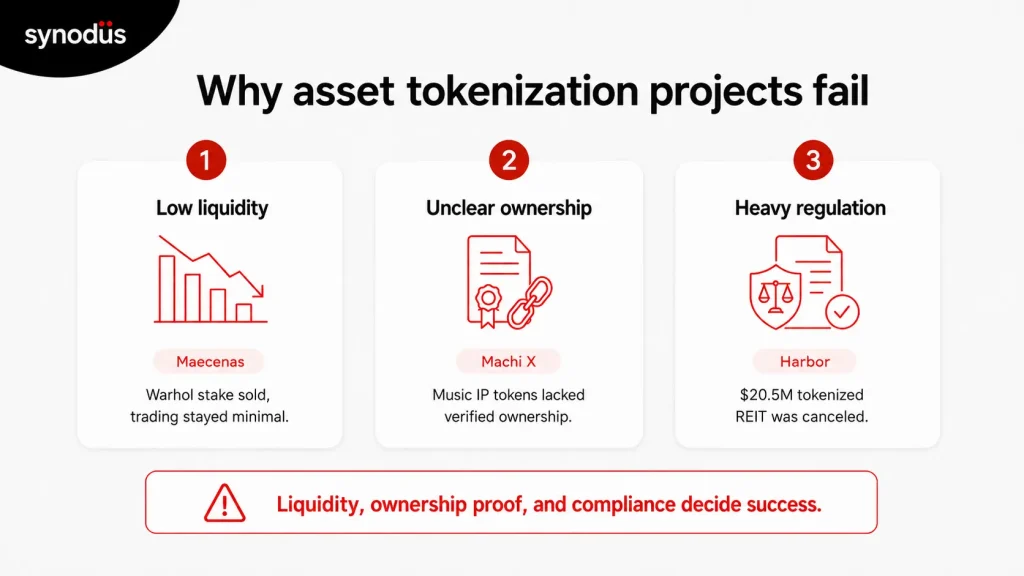
Low liquidity kills a token even when the underlying asset is valuable. In 2018, Maecenas sold a 31.5% stake in Andy Warhol’s “14 Small Electric Chairs” for $1.7 million, betting that tokenization would make the painting easier to trade than the physical original. It did not. Trading volume on Maecenas’ own exchange stayed minimal, and the ART token later lost nearly all its value. Tokenizing an asset does not create buyers for it.
Unclear ownership makes a token inaccurate no matter how well it is built. Machi X launched a marketplace for tokenizing music copyrights, letting fans buy fractional IP tokens directly from artists. The link between each token and the underlying copyright was never independently verified, and the project wound down soon after launch. A token can only be as trustworthy as the ownership record behind it.
Heavy regulation adds cost and delay that a token does not remove. Harbor‘s first tokenized real estate deal, a $20.5 million REIT for a student housing project in South Carolina, was canceled in 2019 after the offering ran into the same securities requirements that apply to any private placement.
For how these rules apply specifically to property, see the regulatory landscape for real estate tokenization. Tokenizing a regulated asset does not exempt it from the regulation already covering it.
Summary
Tokenization already works for real estate, art, gold, wine, supply chains, currency, bonds, and funds, but only when the asset has enough liquidity, clear ownership, and a workable regulatory path. Skip any one of those three and a project stalls, as Maecenas, Machi X, and Harbor found out. Check all three before building.
FAQs
Real estate is one of the most common examples. RealT tokenizes US rental properties and lets investors buy a share for as little as $50 instead of buying the whole building.
Yes. Pax Gold (PAXG) is a token backed 1:1 by one troy ounce of physical gold held in LBMA-accredited vaults, with reserves audited monthly.
Yes. The Hong Kong government issued a $100 million tokenized green bond using Goldman Sachs’ GS DAP protocol, and Siemens issued a one-year digital bond on the Polygon blockchain.
Bitcoin is often described as the first tokenized asset. It represents value directly on a blockchain rather than a digital claim on something held elsewhere.
Supply chain traceability is a growing use case. Fishcoin tokenizes seafood products so buyers and regulators can trace each item from catch to sale.
Yes. BlackRock partnered with Securitize in 2024 to launch a tokenized fund, and Siemens and the Hong Kong government have both issued tokenized bonds.