9 ways to make money in Web3 compared
Here are the 10 best ways to get started making money with Web3:
| Method | Capital needed | Skills needed | Risk | Income type | Best for |
|---|---|---|---|---|---|
| Web3 jobs | None | High | Low | Active | Professionals |
| Freelaning and service | None | Medium to high | Low | Active | Developers, designers, marketers |
| Bounties, grants and communities | Low or none | Medium to high | Low to medium | Active | Builders and contributors |
| Content and digital products | Low | Medium | Medium | Active | Creators |
| Crypto staking | Yes | Low to medium | Medium | Passive or semi-passive | Token holders |
| DeFi lending and liquidity | Yes | Medium | High | Passive or semi-passive | Experienced users |
| Airdrops and ecosystem rewards | Low | Medium | High uncertainty | Variable | Active Web3 users |
| Crypto investing and trading | Yes | Medium to high | Very high | Active or long-term | Experienced investors |
| Build a Web3 product | High | High | Business risk | Business | Founders and startups |
If you are new to Web3, skill-based methods are often easier to understand because you are paid for work rather than depending directly on token prices.
Capital-based methods can generate returns, but your money remains exposed to market, protocol, and security risks.
Make money in Web3 with your skills
You do not need a large crypto portfolio to make money in Web3. You can use skills you already have and work for companies, projects, or communities operating in the industry.
1. Get a job in Web3
Getting a Web3 job is one of the most straightforward ways to earn from the industry without investing your own money in crypto.
Web3 companies need much more than blockchain developers. Common roles include:
- Blockchain and smart contract developers
- Frontend and backend engineers
- Product managers
- UX/UI designers
- QA and security specialists
- Data engineers and analysts
- Compliance specialists
- Business development and sales teams
- Content writers
- Community managers
- Marketing specialists
Technical roles may require experience with Solidity, Rust, JavaScript, blockchain APIs, wallets, or smart contracts.
For non-technical roles, understanding how Web3 products work can be more important than knowing how to write blockchain code.
How to get started
- Identify which of your existing skills can transfer to Web3.
- Learn the basic concepts behind blockchain, wallets, smart contracts, and tokens.
- Build a portfolio or contribute to an open-source project if you are applying for a technical role.
- Search company career pages, Web3 job boards, developer communities, and LinkedIn.
- Check how compensation works if part of your salary is paid in tokens.
The main advantage is that your income does not depend directly on crypto prices. However, if a large part of your compensation is paid in tokens, its value can still change significantly.
2. Freelance or offer Web3 services
You can also work with Web3 companies without joining one full-time. If you already have technical, creative, or business skills, freelancing can be one of the easiest ways to enter the industry.
Common services include:
- Smart contract development
- Blockchain integration
- Web and mobile development
- UX/UI design
- QA and testing
- Smart contract security testing
- Blockchain data engineering
- Analytics
- Technical writing
- Product consulting
- Web3 marketing
- Community management
Developers may work on DeFi platforms, wallets, exchanges, tokenization products, or dApps. Designers can focus on wallet onboarding, transaction flows, dashboards, or NFT marketplaces. Marketers and community specialists can support project launches, content, social channels, and user communities.
You can find projects through freelance platforms, Web3 job boards, hackathons, developer communities, or direct outreach.
Before starting a project, make sure the contract clearly defines:
- Scope
- Deliverables
- Timeline
- Payment schedule
- Payment currency
- Intellectual property ownership
Be careful when clients offer payment entirely in their own token. The value of that payment can change significantly before you can sell it.
3. Earn through bounties, grants and community contributions
Many Web3 ecosystems reward users who help improve their technology or community. Possible opportunities include:
- Bug bounties
- Developer grants
- Hackathons
- Open-source development
- Documentation
- Testing
- Research
- Governance contributions
- Community support
- Educational content
Developers can receive grants for building tools or applications that benefit an ecosystem. Programs such as Gitcoin Grants have been used to fund open-source software and digital public goods.
Security researchers can also earn bug bounties by finding eligible vulnerabilities and reporting them responsibly. Non-developers may find opportunities through community programs, documentation, design, research, and content creation.
This can be a good way to build experience while earning money. However, rewards are not guaranteed. Each program has different requirements, and completing work does not always mean you will receive funding.
4. Create Web3 content and digital products
Creators can use Web3 to sell digital products or build direct relationships with their audience. Common models include:
- NFTs and digital collectibles
- Paid communities
- Token-gated memberships
- Premium content
- Digital tickets
- On-chain loyalty programs
- Blockchain-based creator platforms
The important part is not the blockchain itself. You still need something that people actually want to buy. A strong audience, useful product, or valuable experience usually matters more than simply minting an asset.
Sell NFTs and digital collectibles
NFTs can represent art, collectibles, memberships, tickets, game items, or other digital assets. A basic process might look like this:
- Create a crypto wallet.
- Choose a blockchain.
- Select a marketplace.
- Create your digital asset.
- Mint the asset.
- Set a price or supply.
- Promote it to your audience.
Some NFT contracts and marketplaces also support creator royalties from secondary sales. However, royalty enforcement varies between marketplaces, so you should not treat royalties as guaranteed passive income. The biggest challenge is demand. Creating an NFT is easy. Finding someone willing to pay for it is much harder.
Risks to consider
- Low liquidity
- Changing market demand
- Marketplace dependency
- Copyright issues
- Fake collections
- Wallet scams
- Token price volatility
Virtual land and metaverse assets fall into a similar category. They can be bought, sold, rented, or used inside specific virtual platforms. Their value, however, depends heavily on the popularity and long-term activity of the platform.
Make money in Web3 with capital
The next methods require you to put your own assets at risk. Your results may depend on token prices, protocol performance, smart contract security, liquidity, and overall market conditions. Returns are never guaranteed.
5. Stake cryptocurrency
Proof-of-stake blockchains use validators to help secure their networks. Users who participate in staking can receive rewards. Common staking models include:
- Solo staking
- Delegated staking
- Pooled staking
- Liquid staking
The exact process depends on the blockchain. For someone who already plans to hold a token long term, staking may provide additional rewards without actively trading. However, earning more tokens does not automatically mean earning a profit. For example, you may receive staking rewards while the market value of the token falls.
Risks include:
- Token price volatility
- Validator penalties
- Slashing
- Withdrawal restrictions
- Counterparty risk
- Smart contract risk
- Risks related to liquid staking or restaking
Staking is better viewed as a way to earn additional rewards on assets you already plan to hold, rather than a guaranteed source of passive income.
6. Earn through DeFi lending and liquidity provision
Decentralized finance, or DeFi, lets users lend, borrow, trade, and earn from crypto assets through blockchain-based protocols. Two of the most common ways to generate returns are lending your assets and providing liquidity to decentralized exchanges.
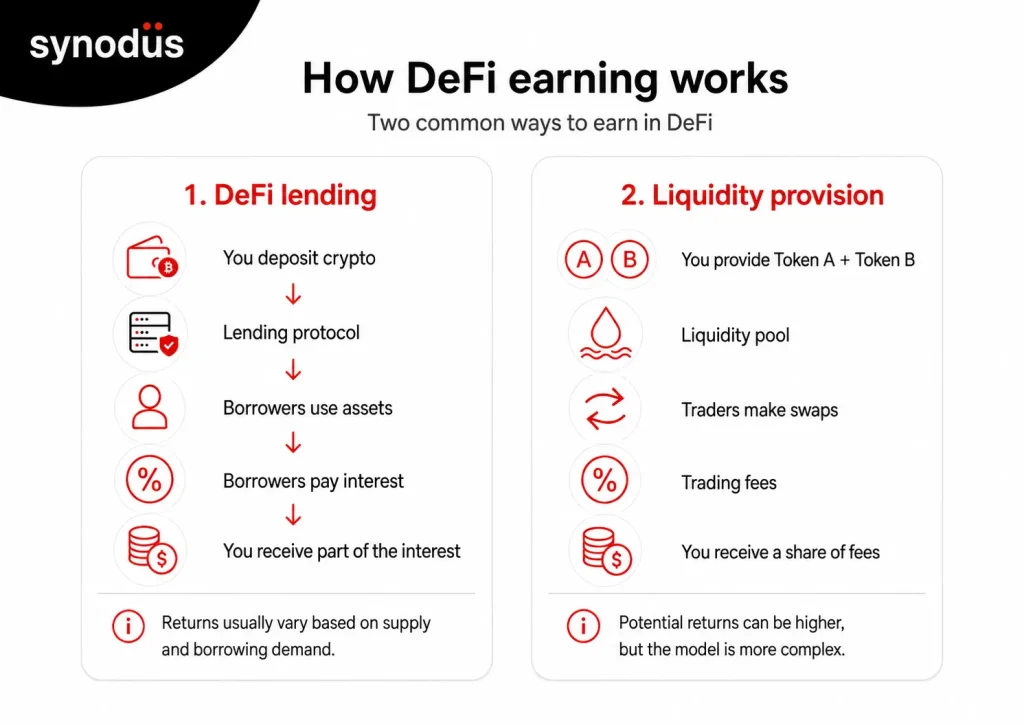
DeFi lending
With DeFi lending, you deposit crypto assets into a lending protocol where other users can borrow them. Borrowers pay interest, and part of that interest is distributed to suppliers. Rates are usually variable, so your returns can change depending on supply, borrowing demand, and market conditions.
Platforms such as Aave and Compound are built around this model. In most cases, borrowers must provide crypto as collateral, which can be liquidated if its value falls below the required threshold.
Liquidity provision
Another option is to provide liquidity to decentralized exchanges such as Uniswap or Curve. You deposit a pair of assets into a liquidity pool that other users trade against, and in return, you can receive a share of trading fees and, in some cases, additional token incentives.
Liquidity provision can offer higher returns than basic staking, but it is also more complex. One of the main risks is impermanent loss, which happens when the value of the assets in a liquidity pool changes differently from simply holding those assets in your wallet.
DeFi also carries risks beyond market volatility. Smart contract exploits, oracle failures, stablecoin depegging, governance problems, and unsustainable token incentives can all affect your funds. A high advertised yield does not necessarily mean a better opportunity, especially if the source of that yield is unclear.
Before putting money into a DeFi protocol, understand how it generates returns, what happens to your assets after you deposit them, and under which conditions you could lose money.
7. Earn from airdrops and ecosystem rewards
Some blockchain projects distribute tokens or other rewards to users who have contributed to or interacted with their ecosystem. Eligibility can depend on activities such as:
- Using a dApp
- Testing a new network
- Providing liquidity
- Bridging assets
- Holding certain tokens
- Participating in governance
- Completing ecosystem activities
- Contributing code or content
Airdrops are not always first come, first served. Many projects use snapshots or historical activity to decide who qualifies. Some users actively explore new blockchain ecosystems in the hope that their previous activity will qualify for future rewards. This can work, but there is no guarantee that a project will launch a token or reward a particular action. Airdrops also attract a large number of scams.
How to reduce the risk
- Verify announcements through official channels
- Never share your seed phrase or private key
- Check URLs carefully before connecting a wallet
- Review what a wallet transaction is asking you to sign
- Avoid random links sent through direct messages
- Consider using a separate wallet for experimental activity
What about Web3 games?
Some blockchain games allow players to earn tokens, NFTs, or other digital assets.
Players may earn through:
- Gameplay rewards
- Tournaments
- NFT assets
- In-game marketplaces
- Ecosystem campaigns
These assets may have real market value, but Web3 gaming should not be treated as dependable income. The value of rewards depends on player demand, token economics, asset liquidity, and the popularity of the game. If players leave the ecosystem, the value of its tokens and digital assets can fall quickly. A better approach is to treat Web3 rewards as an additional benefit of playing a game you already enjoy.
8. Trade or invest in Web3 crypto
Buying cryptocurrency and selling it later at a higher price is another way people try to make money from Web3. For those who prefer a longer horizon, learning how to invest in Web3 crypto rather than actively trading it can also reduce the amount of daily decision-making involved.
Common approaches include:
- Long-term holding
- Day trading
- Swing trading
- Arbitrage
The concept is simple, but the results are unpredictable. Crypto markets can move sharply in either direction, sometimes within a short period. Active trading introduces additional risks related to timing, fees, leverage, liquidity, and emotional decision-making. Beginners should be especially careful with:
- High leverage
- Paid trading groups
- Signals
- Influencers promising guaranteed returns
- Automated trading bots
- Unknown exchanges
- Tokens with low liquidity
Before buying a crypto asset, research:
- What the token is used for
- Total supply
- Token distribution
- Upcoming token unlocks
- Trading liquidity
- Project team
- Custody options
- Regulatory issues
Only use money you can afford to lose. Trading and investing can generate profits, but they should not be treated as predictable income.
Build a business in Web3
Most of the methods above focus on earning as an individual. Another option is to build a Web3 product that generates revenue from users or businesses.
9. Build and monetize a Web3 product
A Web3 product combines blockchain technology with software to solve a specific problem. Examples include:
- Crypto wallets
- Crypto exchanges
- DeFi applications
- Tokenization platforms
- Blockchain marketplaces
- Payment systems
- Blockchain analytics platforms
- Digital asset management tools
- Web3 games
- Enterprise blockchain applications
Before building anything, ask a simple question: Why does this product need blockchain?
Blockchain can be useful when a product needs features such as shared ownership, programmable assets, transparent transactions, decentralized settlement, or records shared between different parties. If a normal database can solve the problem more efficiently, blockchain may not be necessary.
Common Web3 revenue models
Transaction fees
Exchanges, wallets, marketplaces, DeFi platforms, and payment products can charge users each time they complete a transaction.
Marketplace commissions
Platforms connecting buyers and sellers can charge a fixed fee or percentage of each transaction.
Subscription fees
Businesses can charge monthly or annual fees for access to analytics, infrastructure, compliance tools, wallet management, automation, or enterprise features.
API and infrastructure fees
Blockchain infrastructure companies can charge customers for:
- API access
- Node services
- Wallet infrastructure
- Indexing
- Data
- Developer tools
Pricing may be based on usage, transactions, users, or subscription tiers.
Asset and platform fees
Tokenization platforms can charge for services such as:
- Asset issuance
- Investor onboarding
- Asset management
- Transactions
- Reporting
- Administration
The exact model depends on the asset type and applicable regulations.
Premium features
A product can offer basic functionality for free and charge for more advanced features.
Examples include:
- Higher limits
- Advanced analytics
- Reporting
- Automation
- Priority support
- API access
- Enterprise integrations
B2B licensing
A company can also license its blockchain technology to other businesses. This can work well when customers want blockchain functionality without building and maintaining the entire system themselves. Tokens can sometimes support a Web3 business model, but launching a token does not automatically create revenue. A sustainable product still needs customers, demand, security, and a clear reason for people to pay.
How to get started with a Web3 product
Before hiring developers, define the following:
- Problem: What problem does the product solve?
- Users: Who will use it?
- Blockchain need: Why does it require blockchain?
- Revenue: How will the product make money?
- Architecture: What should happen on-chain and off-chain?
- Security: What assets, contracts, keys, or data need protection?
- Compliance: Does the product involve payments, custody, securities, identity, or regulated assets?
- Budget: Can the business model support development and ongoing operating costs?
Answering these questions first can save a significant amount of development time and money later.
How much can you realistically make in Web3?
There is no useful average figure because each method works differently. A developer earning a Web3 salary has a completely different income model from someone trading crypto or launching a startup. A better comparison is income predictability and potential upside.
| Model | Income predictability | Potential upside | Main dependency |
|---|---|---|---|
| Web3 job | Higher | Moderate | Skills and employer |
| Freelancing | Medium to high | Moderate | Skills and clients |
| Grants and bounties | Medium to low | Variable | Contribution and eligiblity |
| Content and digital assets | Low | Variable | Audience and demand |
| Staking | Medium in token terms | Limited to moderate | Capital and token price |
| DeFi | Low to medium | Moderate to high | Capital, protocol and market |
| Airdrops | Very low | Veriable | Eligibility and token value |
| Trading | Very low | High or negative | Market movement |
| Web3 business | Very low initially | Potentially high | Product-market fit and execution |
If your goal is more predictable income, jobs and freelance work generally involve less direct crypto market exposure. If you want returns on capital, you need to accept financial risk.
Building a business can create much larger upside, but it also brings product, development, security, regulatory, and customer acquisition risks. High potential returns usually come with significant trade-offs.
How to choose the right way to make money in Web3
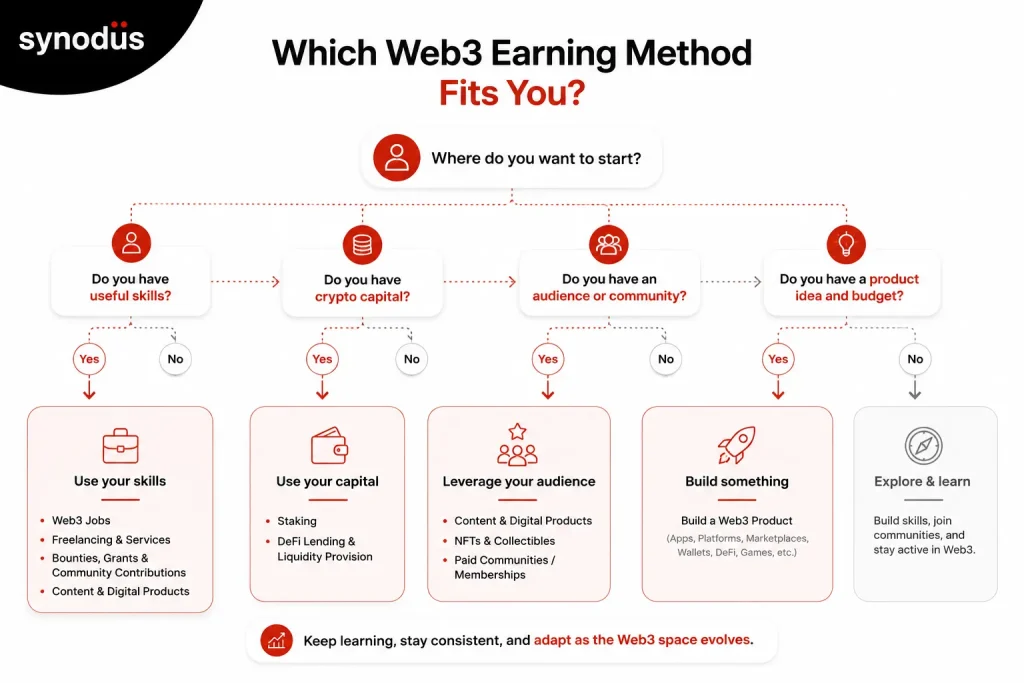
The best option depends on what you already have.
If you have skills but little capital, start with jobs, freelancing, bounties, or grants. If you already own crypto, staking may be easier to understand than more complex DeFi strategies.
Creators can explore digital products, NFTs, memberships, or paid communities. Founders should focus first on the user problem, revenue model, and whether blockchain is actually necessary before investing in development.
Risks to understand before trying to make money in Web3
Before putting in time or money, make sure you understand the main risks:
- Market volatility: Crypto prices can change quickly, so rewards from staking, DeFi, gaming, or airdrops may lose value.
- Smart contract risk: Bugs, exploits, or flawed contract logic can lead to losses even on established platforms.
- Phishing and wallet theft: Fake websites, malicious links, and unsafe transaction approvals can compromise your wallet.
- Rug pulls and scams: Be cautious with projects that promise unrealistic returns, hide token allocations, or pressure users to invest quickly.
- Private key risk: Losing your seed phrase or exposing your private key can result in permanent loss of funds.
- Protocol and counterparty risk: Exchanges, bridges, staking providers, stablecoins, and DeFi platforms can fail or become insolvent.
- Regulation and tax: Crypto rules vary by country, and different earning methods may have different tax or compliance requirements.
Want to build a Web3 business instead?
Most of the methods above focus on earning as an individual. Building a Web3 business is different.
A successful Web3 product needs a real problem to solve, users willing to pay for it, a sustainable business model, secure architecture, and enough funding to support development and operation.
If you are considering a wallet, exchange, DeFi platform, tokenization product, or another blockchain application, start with our guide on how to build a blockchain app before choosing a development approach.
You can then review blockchain app development cost to understand how architecture, integrations, security, infrastructure, and product complexity affect your budget.
For more specialized products, you can also explore how to build a crypto exchange or how to create a crypto wallet.
Synodus works with businesses building production-ready blockchain applications, including wallets, exchanges, DeFi products, and tokenization platforms.
The goal should not be to add blockchain because it is popular. It should be to determine whether blockchain solves the problem better and whether the product has a business model that can support long-term development.
Conclusion
There are many ways to make money in Web3, but the right one depends on what you already have.
If you have useful skills, jobs, freelancing, and bounties are good places to start without risking much capital. If you already own crypto, staking and DeFi can generate additional rewards but come with financial and technical risks. Trading, airdrops, and digital assets can also make money, but returns are much less predictable.
For founders, the opportunity is different. You can build a Web3 product and generate revenue from fees, subscriptions, commissions, or other services. The key is to start with a real user problem and a sustainable business model, not just the technology.
FAQs
Yes. You can earn through jobs, freelancing, grants, content, staking, DeFi, airdrops, crypto investing, or building Web3 products. Each option has different skill, capital, and risk requirements.
Web3 jobs, freelancing, bounties, grants, community work, and content creation can all be started without investing significant amounts of money in crypto.
Skill-based work generally has less direct exposure to crypto market movements. Jobs, freelancing, and professional services still depend on finding employers or clients, so income is never guaranteed.
Staking and some DeFi activities can generate rewards without active trading. If you are deciding whether to invest in Web3 through these methods, keep in mind that token prices, smart contracts, protocols, validators, and counterparties can all affect your returns.
Yes. Web3 businesses can generate revenue from transaction fees, subscriptions, marketplace commissions, infrastructure services, licensing, and asset-related services. Success still depends on demand, execution, security, and compliance.
The methods with the most current interest are Web3 jobs, staking, and DeFi, since they let you earn Web3 rewards without relying entirely on token price movement. Airdrops and trading can offer higher upside but come with much lower predictability.