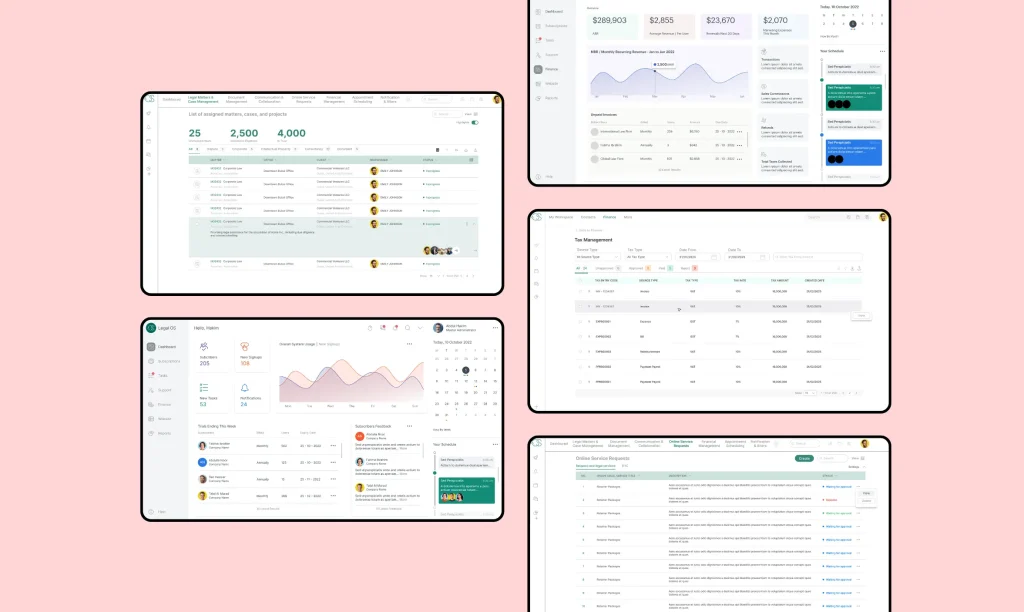
Our client is a legal tech innovator. They had observed that law firms were struggling under the weight of their own administrative processes, as most them were still relying on disconnected spreadsheets, siloed CRMs, and manual billing tools.
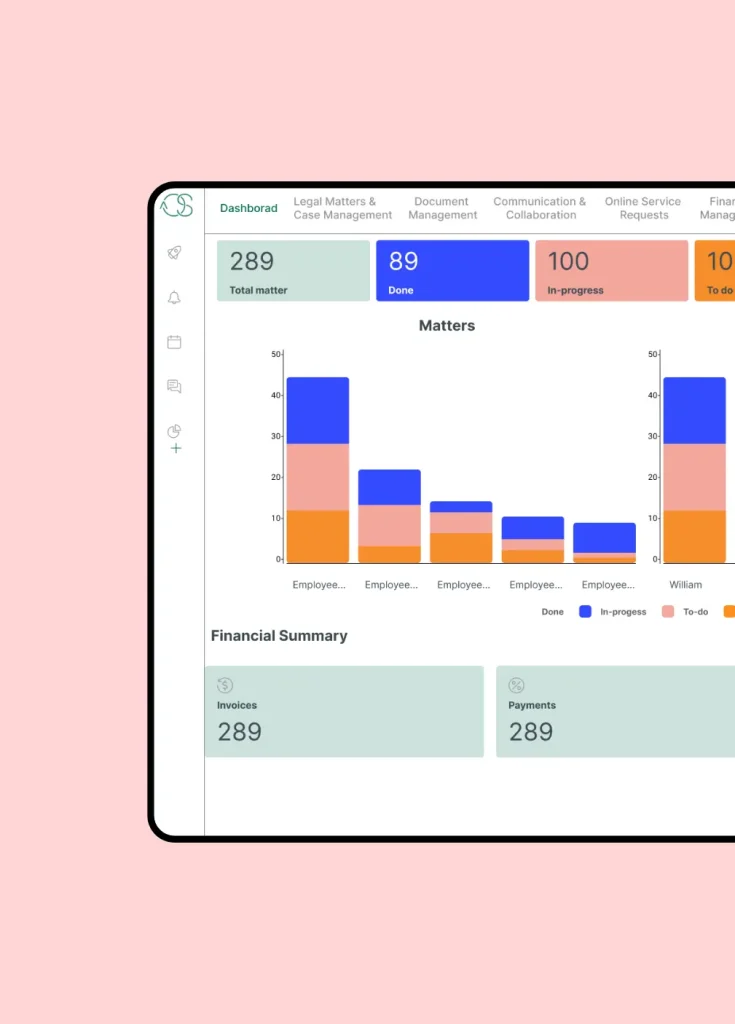
Therefore, our client approached us with a clear, ambitious vision. They wanted to build a multi-tenant SaaS platform , delivered as part of our Web application development – a system that could handle the complexity of international law firms while maintaining absolute data security.
We assembled a dedicated team of 7 experts, including a PM, a BA, backend and frontend engineers, and a QC specialist to build a solution that would integrate case management, document libraries, billing, and compliance into one cohesive digital workspace.
The challenges we faced
As we dove into the project, we identified three major hurdles that defined our development strategy.
1. Operational inefficiency
Our audits revealed that lawyers were losing 25%–30% of their billable hours to non-billable administrative tasks, tracking billing, and internal communications.
2. The Multi-tenancy hurdle
We had to ensure ironclad data isolation. Every firm using the platform needed to feel like they had their own private, secure instance, even though they were sharing a scalable AWS infrastructure.
3. Global localization
Creating a seamless user experience that natively supported both Left-to-Right (LTR) and complex Right-to-Left (RTL) layouts (specifically for Arabic) was a massive technical challenge that required a complete rethink of our UI/UX framework.
Our work
To overcome these challenges, we engineered the platform using Angular 14, Node.js 18, and Django 3.8, underpinned by a robust MySQL and ElasticSearch backbone, forming a solid foundation for scalable Data Analytics.
- Architectural sovereignty – We implemented a multi-tenant cloud architecture that guaranteed strict data isolation, ensuring no risk of cross-tenant data leakage.
- Modular “legal-first” design – Instead of building generic tools, we developed specific modules for Finance, HR, Compliance, and Business Development that mirrored actual legal workflows.
- Dynamic UI framework – We built a custom localization engine that allowed the platform to flip between LTR and RTL layouts instantly, ensuring a native experience for our global user base.
- Operational accelerators – We delivered the Subscriber Portal for internal firm management and a Landing Page Builder, giving firms the power to capture leads and manage their digital presence within the same platform.
The meaningful impact
The impact of our work was felt almost immediately upon deployment.
By replacing fragmented legacy tools with a unified platform, we successfully reclaimed those lost administrative hours by 25-30%. Lawyers were finally able to pivot away from manual data entry and back to high-value legal work.
Users also praised the platform’s departmental structure, noting that it finally brought order to their “digital chaos.”
Most importantly, our architecture provided the compliance and data security that firms required to trust the cloud with their most sensitive client matters.
Our road ahead
We aren’t stopping at administrative automation. Our team is currently deep in development for the next phase of the ecosystem.
We are building a secure client-facing portal that will allow end-clients to interact directly with their legal teams, securely share documents, and track the real-time progress of their matters.
Alongside this, we are preparing for a full-scale international launch, which will empower law firms everywhere to deploy their own customizable websites directly through the platform.
Looking further ahead, we are also experimenting with AI-driven document analysis and workflow automation to evolve our solution from a standard management tool into a predictive, intelligent legal assistant.
How useful was this post?
Click on a star to rate it!
Average rating / 5. Vote count:
No votes so far! Be the first to rate this post.