A hospital round may end at the patient’s bedside, but the paperwork often doesn’t.
For doctors and nurses, daily clinical work has traditionally involved recording information on paper before entering it again into the hospital’s information system (HIS). This creates additional administrative work in an environment where medical staff are already moving between patients and managing multiple clinical tasks.
Moving these workflows onto a mobile application sounds straightforward. Making that application work across hospitals with different HIS systems, clinical forms, and operating requirements is another challenge entirely.
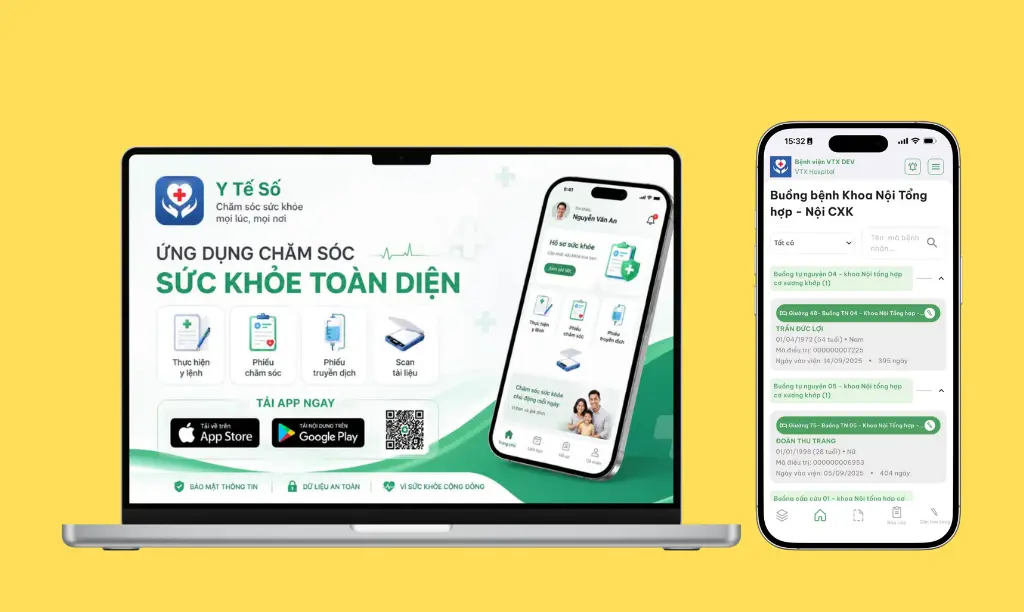
That was the problem Synodus set out to solve with App Y tế số, a digital bedside care platform built from scratch. Today, the application is operating across 19 hospitals in Vietnam, supporting clinical documentation and nursing activities while connecting data back to existing hospital systems.
Project goal: Build a shared digital platform that allows doctors and nurses to manage bedside clinical workflows, reduce repetitive paperwork and data entry, and synchronize clinical information with existing hospital systems, while remaining adaptable as more hospitals adopt the product.
About our client
App Y tế số serves healthcare institutions across Vietnam, including major hospitals such as Bach Mai Hospital, Ha Dong General Hospital, and Can Tho Central General Hospital.
The platform is currently deployed across 19 hospitals, covering institutions with different clinical processes, organizational structures, and hospital information systems.
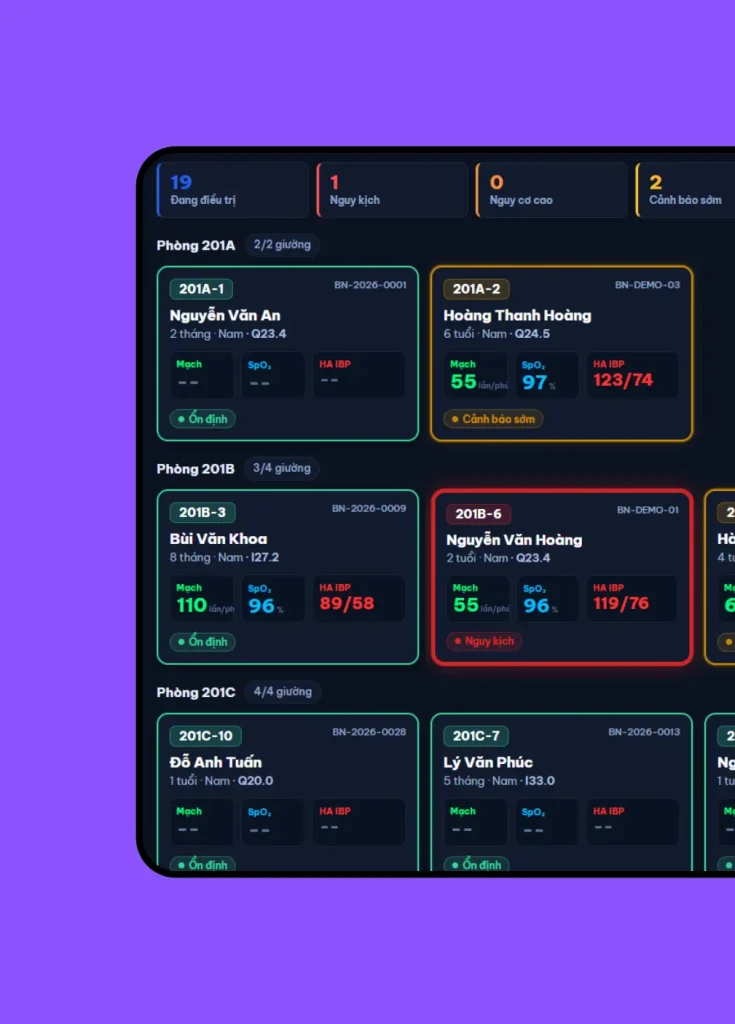
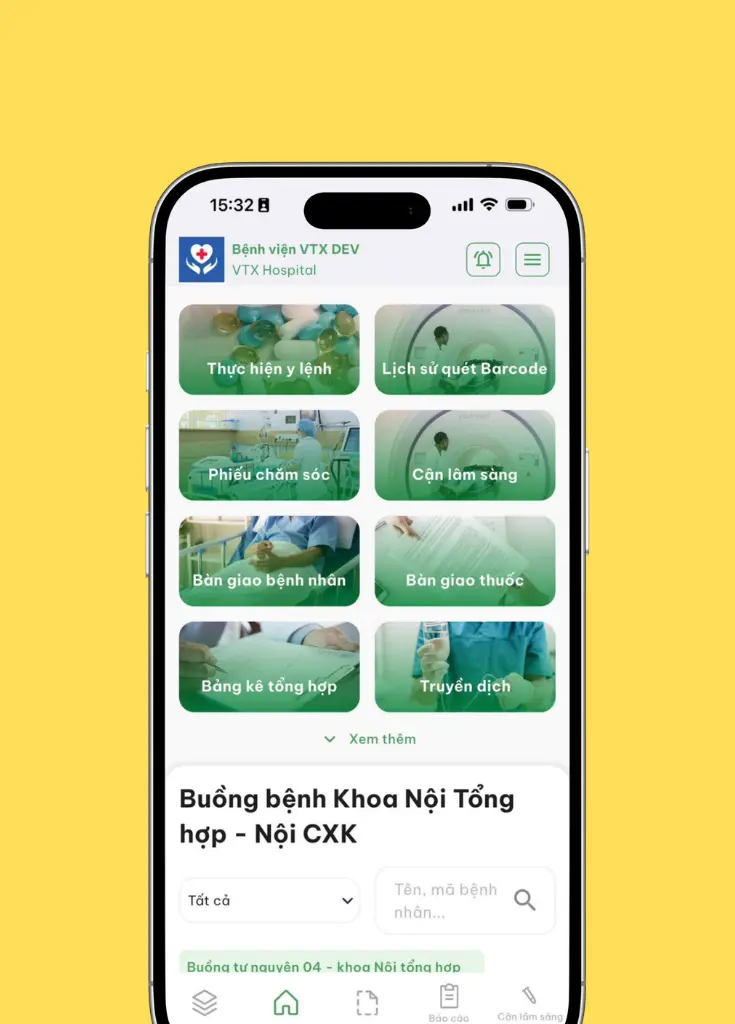
Its primary users are doctors and nurses who perform clinical activities directly at the patient’s bedside. These include reviewing patient information, carrying out medical orders, documenting nursing care, monitoring vital signs, and managing patient handovers.
In this environment, the application is not intended to replace a hospital’s existing HIS. Instead, it provides a mobile layer for bedside operations, allowing clinical staff to record information where care takes place and synchronize relevant data with the hospital’s established systems.
That role makes interoperability essential. Each hospital has its own HIS environment and documentation requirements, but the product must remain consistent enough to be maintained and developed as one shared platform.
| Industry | Healthcare |
| Country | Vietnam |
| Service | Software Delivery (mobile app development, web development, HIS Integration & data synchronization) |
Business context: One clinical workflow, many hospital systems
The challenge began with a familiar part of hospital operations: paperwork.
During daily rounds, doctors and nurses need to record patient observations, medication administration, clinical procedures, and other care activities. Traditionally, much of this information was first documented on paper and then entered into the HIS.
This created repetitive work for clinical staff and made it more difficult to capture, retrieve, and update patient information directly at the bedside.
But replacing paper was only one part of the problem.
Different hospitals, different systems
Each hospital already had its own HIS, and the underlying systems were not necessarily built in the same way.
The App therefore needed to work with different integration environments while ensuring that clinical data entered through the mobile interface remained consistent with the hospital’s existing records. This was particularly important for activities such as medication administration, clinical service execution, nursing documentation, and infusion records.
Data accuracy also mattered beyond daily care. Information recorded through the App needed to match the HIS because the hospital relied on its HIS data to prepare XML reports for health insurance submission.
An integration that created inconsistent records could therefore affect more than the user’s experience. It could create additional reconciliation work in the hospital’s downstream reporting process.
A shared platform that cannot afford disruptive changes
As App Y tế số expanded, another challenge emerged: keeping the product stable while continuously adapting it to new hospital requirements.
Each institution had its own forms, workflows, acceptance criteria, and feature requests. At the same time, doctors and nurses at hospitals already using the App depended on it for daily work.
A change introduced for one hospital could not be allowed to disrupt existing functionality elsewhere. Likewise, excessive data requests to a hospital’s HIS could affect the performance of the system on which that hospital already relied.
The central challenge was therefore not simply to digitize bedside documentation. It was to build and operate one shared clinical product that could work across different hospital environments without becoming a collection of separately maintained applications.
Project workflow
Synodus approached the project as a continuously evolving healthcare product rather than a one-time software deployment.
The team first established the core nursing workflows, expanded adoption across hospitals, and then continued developing more advanced clinical and administrative capabilities based on real operational needs.
| Phase | Scope | Timeframe |
|---|---|---|
| 1. Build the core product | Develop the shared backend and Flutter mobile app; digitize core nursing workflows; integrate with the first hospital HIS environments; release on App Store and Google Play | 2025 |
| 2. Expand hospital adoption | Roll out the platform to additional central, provincial, and district-level healthcare institutions; support hospital-specific requirements and operational feedback | 2025 – Dec 2025 |
| 3. Extend clinical capabilities | Continue hospital-specific releases and production support; develop doctor-facing workflows and configurable administration capabilities | 2026 – Present |
The sequence reflected a deliberate product decision.
Nursing workflows were prioritized because nurses were among the most frequent users of bedside documentation and care-management processes. Digitizing these activities first allowed the team to introduce the product into daily clinical work and gather practical feedback before expanding its scope.
A shared product foundation also came before more extensive hospital-specific configuration. This helped the team establish a common system while preparing for differences in forms, workflows, and operational requirements across hospitals.
The same principle shaped data integration: App-to-HIS synchronization came first, with two-way synchronization planned for a later stage once the relevant hospital and HIS providers agreed on the integration approach.
Solution: One platform for different hospital environments
Synodus built App Y tế số as a mobile-first clinical platform that allows doctors and nurses to document bedside activities while keeping relevant information connected to their hospital’s existing HIS.
Rather than building separate applications for individual hospitals, the team developed one shared product foundation, using Flutter for iOS and Android, NestJS for the backend, and React for web administration. This approach supports continuous product development while accommodating different hospital workflows and integration requirements.
The solution focuses on three core capabilities:
| Capability | What it delivers |
|---|---|
| Digital bedside workflows | Mobile patient and ward management, medication and clinical service order execution, nursing care records, infusion documentation, vital-sign monitoring, patient handovers, nutritional screening, and supported digital signing |
| HIS integration | Synchronizes relevant data from the App to each hospital’s HIS, supporting consistent clinical records and downstream insurance reporting |
| Shared, adaptable platform | One Flutter codebase and shared backend, with asynchronous processing through Bull/Redis and evolving configuration capabilities for hospital-specific forms |
The first release focused on nursing workflows. Doctor-facing functions, expanded administration capabilities, and two-way HIS synchronization are part of the product’s ongoing development.
Process: Building one product for 19 hospitals
Nursing workflows came first
The team prioritized nursing workflows because nurses perform frequent bedside activities throughout the day. Digitizing these tasks first gave hospitals a practical starting point and allowed Synodus to collect feedback from actual clinical use before expanding into doctor-facing functions.
This decision shaped the initial product scope, from medication administration and vital-sign monitoring to care records and patient handovers.
One product, different hospital requirements
As more hospitals adopted the App, the challenge shifted from building individual features to managing different requirements without fragmenting the product. Synodus established a structured delivery process for each hospital, beginning with clinical workflow assessment and written scope approval, followed by development, testing, acceptance, training, and ongoing support.
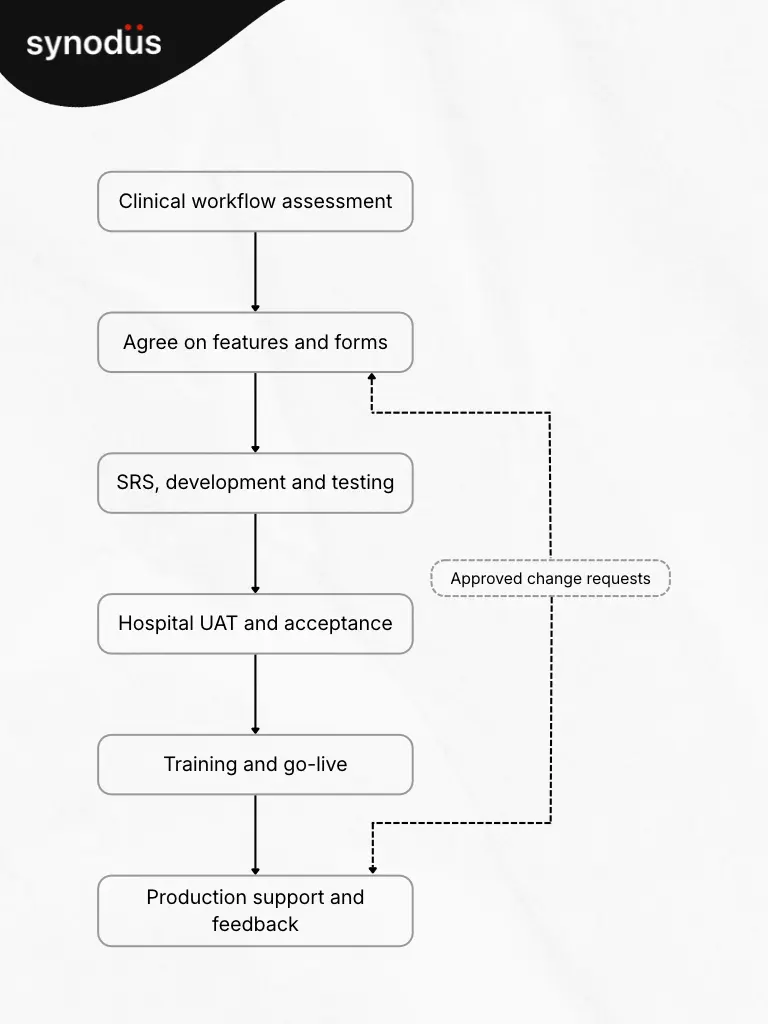
This process gave both the hospital and product team a clear basis for managing changes and delivery commitments. For example, at Thai Binh Provincial General Hospital, Phase 1 was accepted on September 1, 2026. The project’s 41-feature scope included 28 implemented features and 13 additional items, with further updates scheduled through November.
By separating initial acceptance from subsequent improvements, the team could deliver agreed functionality without keeping the entire project waiting for every hospital-specific request.
Protecting existing HIS operations
Integration required particular care because each hospital operated a different HIS environment. Some requested capabilities depended on APIs that HIS vendors had not yet provided, while excessive requests from the App could affect HIS performance.
The team responded by reducing API request frequency, using caching, and limiting retrieved data where necessary. Integration-dependent features were scheduled only when the required APIs and agreements were available.
The same caution guided the decision to implement App-to-HIS synchronization first, leaving two-way synchronization for a later stage once the hospital, HIS provider, and App team agreed on the approach.
After go-live, the product team continued gathering feedback through hospital support channels and translating it into fixes, documentation updates, and new releases. This ongoing feedback loop became essential to maintaining one shared platform across multiple hospitals.
Outcome: A clinical product in daily use
App Y tế số is now operating across 19 hospitals in Vietnam, providing a shared mobile platform for bedside documentation and supported clinical workflows.
Beyond the number of hospital deployments, actual usage data offers a clearer picture of adoption.
Product adoption and usage
| Metric | Recorded result |
|---|---|
| Hospitals deployed | 19 |
| Monthly active users | ~14,000 |
| Weekly active users | ~9,400 |
| Daily active users | ~5,300 |
| Peak concurrent users | Nearly 1,000 |
| Usage time per active user over 28 days | Over 4 hours |
Operational improvements
| Before | With App Y tế số |
|---|---|
| Clinical information recorded on paper before later HIS entry | Supported bedside activities can be recorded directly on the mobile app and synchronized to HIS |
| Paper-based care records and signing steps | Digital forms and supported in-app signing reduce paperwork for adopted workflows |
| Different hospital requirements handled through separate operational arrangements | One shared product foundation supports multiple hospitals and their integration requirements |
Continuous production support
The product team also handles an average of 80–100 support requests per month, with a reported 96% handling rate.
Together, the deployment scale, usage figures, and support activity demonstrate that App Y tế số has progressed beyond initial product development into an actively used and continuously maintained healthcare platform.
Verified figures for time saved, documentation error reduction, or hospital operating cost savings are not yet available.
What’s next?
With the core nursing platform operating across 19 hospitals, Synodus continues to expand App Y tế số through new hospital deployments, doctor-facing workflows, and more flexible configuration of hospital-specific forms.
The roadmap also includes deeper HIS synchronization and connections with the broader digital healthcare ecosystem, including EMR, Smart ICU, and PACS.
The longer-term direction is to bring more clinical activities into connected digital workflows while allowing hospitals to continue using the systems and processes essential to their operations.