Two government agencies may hold information about the same person, business, or public asset, yet describe that information in completely different ways. One system may use a different field name, data format, or reference code from another. Both may work perfectly well on their own, but connecting them requires additional interpretation, mapping, and reconciliation.
Across a national digital ecosystem, these differences become more than a technical inconvenience. They can slow cross-agency data sharing, complicate public services, and make it difficult to establish which information should be treated as authoritative.
Vietnam faced a fundamental challenge: how to establish a common data language across government organizations without requiring them to replace the systems they already depended on.
To address this, Synodus, part of VTX Group, contributed expertise in national data architecture and governance consulting alongside the end-to-end development of a digital Data Catalog platform. The engagement combined the development of common governance principles and data definitions with software designed to manage, maintain, and apply those standards.
A major national milestone came on November 4, 2025, when Decision No. 2439/QĐ-TTg formally issued Vietnam’s National Data Architecture Framework, National Data Governance and Management Framework, and Common Data Dictionary (Version 1.0).
The initial Data Catalog platform was also developed and handed over for trial use, establishing a digital foundation for managing these standards beyond their original policy documents.
Project goal:
Establish a common data language for government organizations and build a centralized, secure digital platform to manage, standardize, and maintain over time. The long-term objective is to make public data easier to discover, understand, govern, and share across existing systems, while preserving security, accountability, and the autonomy of participating organizations.
About the client
The client is a national public-sector authority responsible for coordinating government data architecture, governance frameworks, and common data standards in Vietnam. Its responsibilities extend across central government ministries, sector-specific agencies, local authorities, and the national databases that support public administration.
Unlike a conventional enterprise customer, the authority’s work has implications beyond its internal operations. Its policy and technical frameworks provide common direction for organizations responsible for creating, managing, connecting, and using public-sector data.
This requires a combination of regulatory understanding, data architecture expertise, and practical software engineering. The resulting standards must be consistent enough to support nationwide interoperability while remaining adaptable to the different business processes and legacy systems already in use.
Business context & Challenge
Years of digital transformation had created a broad landscape of government information systems and databases. Ministries, sectoral organizations, and local authorities had developed systems to support their own responsibilities, often using different data structures, naming conventions, and classification standards.
These systems could serve their original purposes effectively. The difficulty emerged when information needed to cross organizational boundaries.
Without common semantic definitions, exchanging data required organizations to determine what fields meant, how codes corresponded, and which sources should take precedence when records conflicted. In many cases, these decisions had to be negotiated and implemented separately for each integration.
As the number of participating systems increased, so did the complexity of maintaining those connections.
The consequences extended beyond technology. Fragmented data definitions could contribute to repetitive information requests, longer cross-agency verification processes, and uncertainty over which organization owned or maintained a particular data asset. They also complicated efforts to create consistent datasets for analysis and future AI applications.
The central challenge was therefore semantic consistency at national scale.
A conventional replacement strategy would have been impractical. Many government organizations already relied on established systems, some of them developed years earlier and closely tied to operational and regulatory requirements. Rebuilding every database around a new national model would introduce significant cost, disruption, and risk.
Instead, the project needed a common framework capable of connecting different definitions through standardized terminology and flexible semantic mapping.
Security and governance added further complexity. The solution had to support sensitive public-sector information, clearly defined administrative responsibilities, controlled access, and approval processes involving multiple government organizations.
The challenge was to establish common rules without assuming that every participating system could or should become identical.
Project workflow
Why the standards had to come before the software
The project followed a governance-first approach, with institutional and architectural decisions informing the design of the digital platform.
Rather than developing software around assumptions that might later conflict with national standards, the team organized the work around five connected stages.
| Phase | Focus | Key output |
|---|---|---|
| 1. Institutional research | Review legal requirements, governance responsibilities, and the national scope of data management. | Regulatory and organizational foundations for the framework. |
| 2. Architecture and governance | Define national, sectoral, and local data layers, governance principles, and responsibilities. | National Data Architecture Framework and Data Governance and Management Framework. |
| 3. Dictionary standardization | Design common data definitions, metadata structures, identifiers, classifications, and version-management principles. | Common Data Dictionary, Version 1.0. |
| 4. Digital platform development | Translate governance rules into catalog management, search, approval, mapping, and integration capabilities. | Initial Data Governance and Data Catalog platform. |
| 5. AI assistance and adoption support | Develop semantic-review assistance, support validation, handover, and continued application of the standards. | AI-assisted review approach and ongoing implementation support. |
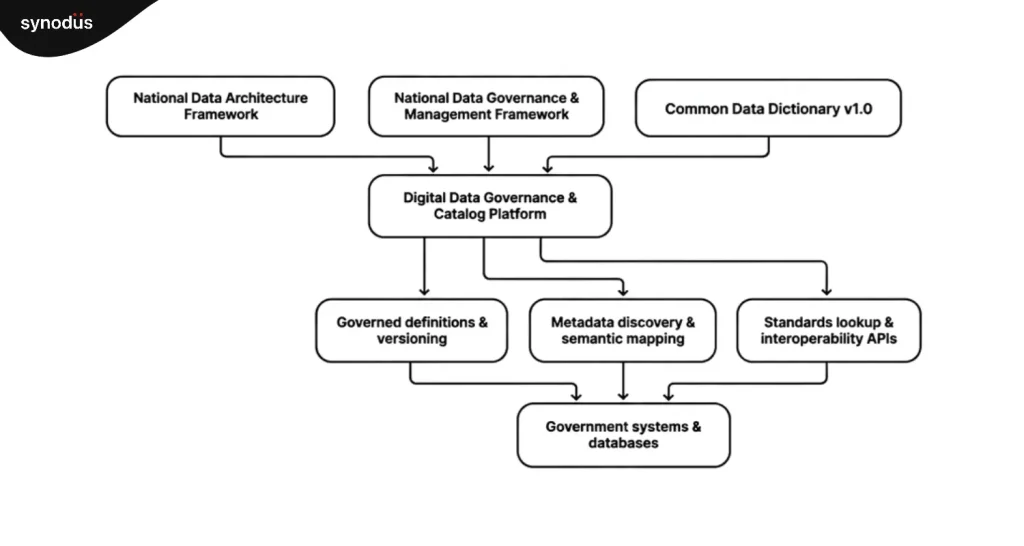
The sequence was intentional. The national architecture established how different data domains should relate to one another. Governance rules defined responsibilities and approval authority. The common dictionary established the structure and meaning of the information the platform needed to manage.
Only then could the software implement those principles in a consistent way.
The framework and standards work also involved specialist workshops, technical reviews, cross-agency consultation, and revisions before formal approval. Software delivery proceeded through architecture design, internal testing, user acceptance testing, controlled trials, and module-level handover.
Solution
From a governance framework to a working digital platform
Synodus’s approach combined two closely related workstreams: Data Solutions consulting to help define the governance model, and Software Delivery to translate that model into a usable platform.
The consulting work covered data architecture, governance responsibilities, and the structure of the Common Data Dictionary. The engineering work focused on building the applications and operational controls needed to maintain those definitions throughout their lifecycle.
This combination was important because governance rules cannot simply be copied into software as static documentation. They need to become clear processes governing how definitions are proposed, reviewed, approved, published, updated, and accessed.
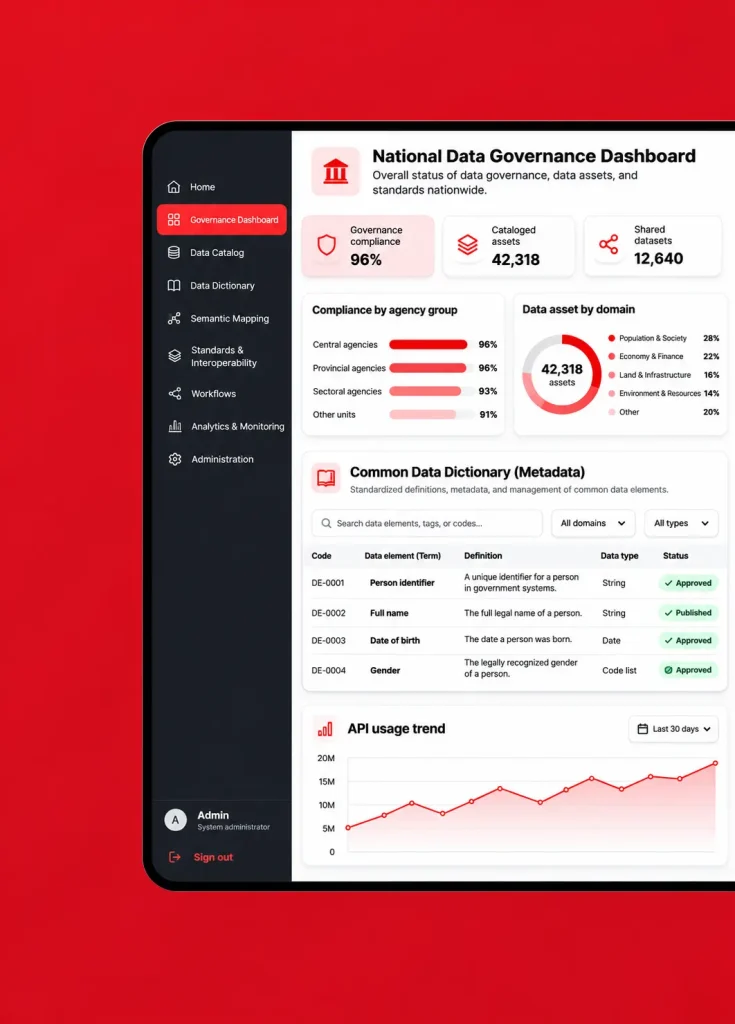
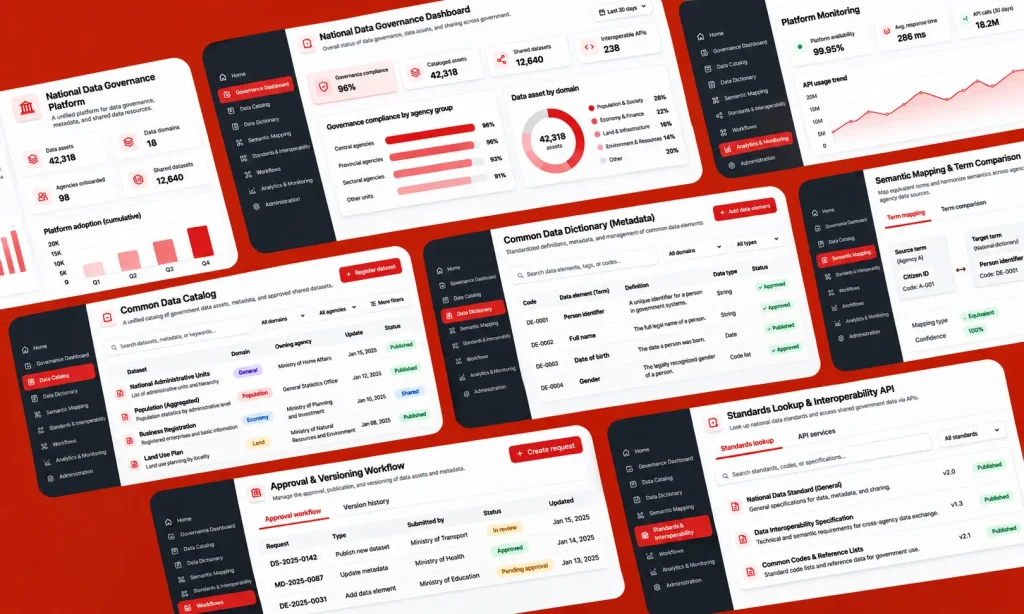
The team developed a modular Data Governance and Data Catalog platform designed for deployment within controlled government infrastructure. Its core capabilities support the management of data definitions, discovery of existing data assets, semantic alignment, and controlled distribution of standards.
| Platform capability | Role in national data governance |
|---|---|
| Common Data Dictionary Management | Maintains definitions, identifiers, reference codes, version histories, and approval workflows for shared data standards. |
| Data Catalog & Metadata Registry | Organizes information about data assets, classifications, and responsible organizations to support discovery and governance. |
| Search & Standards Lookup | Enables authorized users to find definitions, data types, and reference information for use in system development and integration. |
| Semantic Mapping Engine | Supports the alignment of sector-specific terms and fields with common national definitions without requiring immediate replacement of existing databases. |
| Interoperability APIs | Provides a technical interface for external systems to access and synchronize approved reference information under controlled conditions. |
Preserving existing systems through semantic mapping
One of the most consequential design choices was to avoid a wholesale replacement of legacy databases.
Instead, the platform uses a semantic mapping approach: organizations can retain their existing systems while associating local fields and terminology with standardized national definitions.
For example, two databases may represent the same underlying concept using different names or formats. A common dictionary provides a reference definition, while the mapping layer records how each system’s terminology relates to that shared meaning.
This allows national standardization to develop alongside established operational systems rather than requiring every organization to redesign its databases at once.
The platform’s modular, service-oriented architecture also supports future expansion. Its underlying approach combines a relational data store for catalog and metadata records with indexed search capabilities for efficient discovery.
Deployment is designed to remain on-premises, using containerized components to support controlled operation and maintenance within the client’s security environment.
Process: The engineering decisions behind the platform
Turning policy requirements into software rules
A central challenge for the delivery team was translating governance concepts into precise software behavior.
The authority to propose a data definition is not necessarily the same as the authority to approve or publish it. Similarly, changing an existing standard requires more than editing a database record. The platform needs to distinguish drafts from approved versions, preserve historical definitions, and maintain accountability for changes.
To address this, the consulting and engineering teams worked in parallel across three closely connected areas: data architecture, governance processes, and common dictionary modeling.
Business rules were reviewed before implementation so that the development team could design functionality around agreed definitions and responsibilities. This reduced the risk of building features around interpretations that would later require substantial revision.
The client retained authority over policy, legal interpretation, standards, and formal acceptance. Synodus’s solution architects, technical leads, data engineers, developers, and QA specialists were responsible for the corresponding software architecture, technical implementation, testing, and delivery quality.
The result was an engagement in which policy decisions informed software development, while technical considerations helped identify where governance requirements needed further clarification.
Helping organizations speak the same data language
Creating a common dictionary is not simply an exercise in collecting terminology.
Different agencies may use identical terms for different concepts, or different terms for essentially the same concept. Both situations create problems when systems try to exchange information or developers assume that matching field names guarantee matching meanings.
The platform’s semantic mapping capabilities were designed to address these differences without removing the context in which sector-specific terminology is used.
For each proposed definition, the governance process can establish its intended meaning, relationship to existing terminology, classification, responsible organization, and approval status. This creates a structured basis for reviewing potential conflicts and determining whether a new term should be accepted, mapped to an existing standard, or revised.
The broader engineering objective was to make these decisions visible, repeatable, and maintainable rather than leaving them scattered across individual integration projects.
Using AI to support semantic review, not replace expert judgment
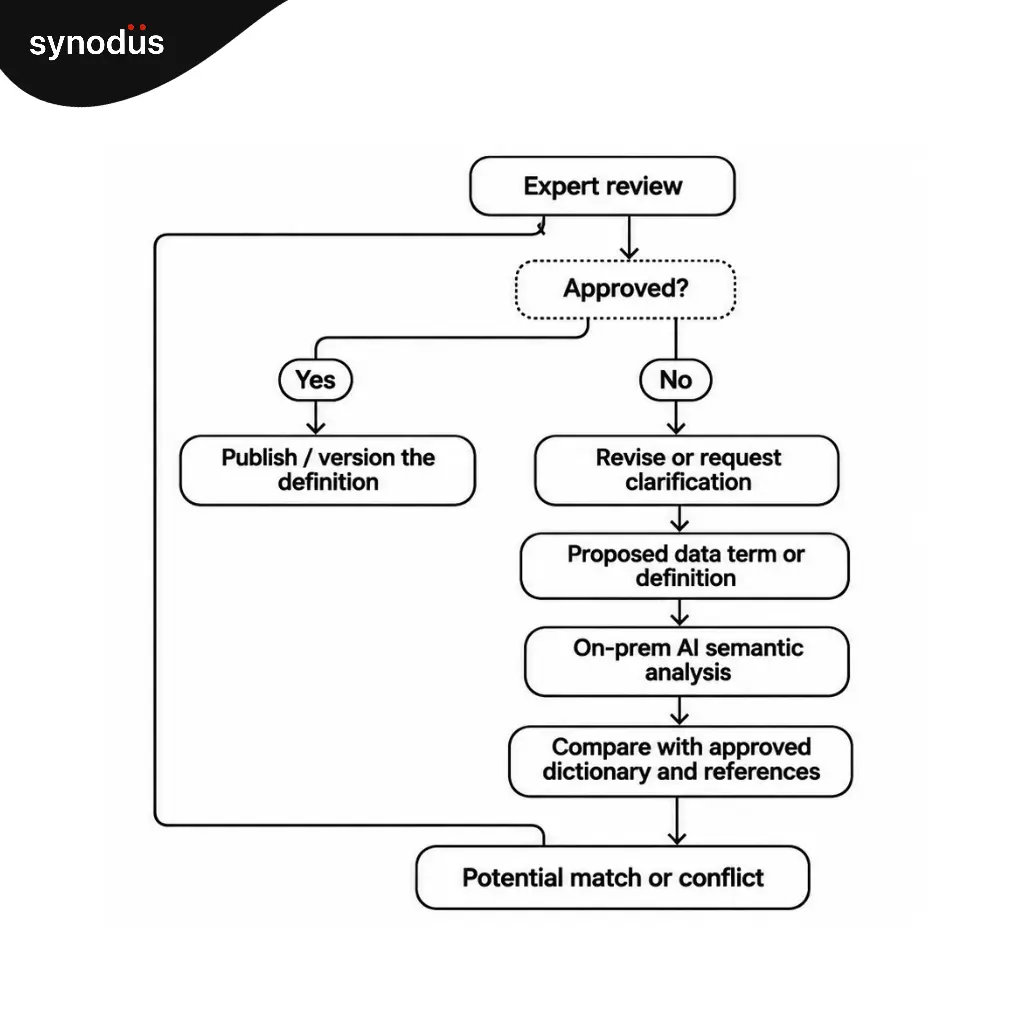
The volume and complexity of government terminology also created an opportunity for AI assistance.
The team explored and integrated an approach using open-source language models deployed within the client’s controlled infrastructure, combined with Retrieval-Augmented Generation (RAG). The purpose was to help identify possible semantic overlap by comparing proposed terms with approved definitions and relevant regulatory references.
The system is designed to assist with two particularly difficult situations: terms that share the same name but carry different meanings, and terms that use different names to describe equivalent concepts.
AI can suggest similarities, highlight possible conflicts, and provide supporting references for review. However, it does not have the authority to establish or modify an official data standard.
Human approval remains the final decision point
Domain specialists must validate the proposed interpretation before an item can progress through the appropriate governance workflow. This separation is especially important when a semantic error could affect how multiple public-sector systems interpret or exchange information.
The AI components are intended to run on-premises, without sending sensitive data to external public-cloud AI APIs. Their role is to support the accuracy and efficiency of expert review, not to automate legal or governance decisions.
The project documentation describes the AI-assisted workflow and integration approach; performance improvements attributable to AI have not yet been publicly quantified.
Outcomes & Proof
A national standard, supported by a digital foundation
The project has reached two significant milestones: the formal issuance of the national frameworks and common dictionary, and the development and handover of an initial digital platform designed to support their implementation.
The first milestone is publicly documented. On November 4, 2025, Decision No. 2439/QĐ-TTg issued three national components:
- The National Data Architecture Framework, defining the overall direction for organizing and connecting government data systems.
- The National Data Governance and Management Framework, establishing principles for managing data responsibilities, quality, security, and use.
- The Common Data Dictionary (Version 1.0), providing shared definitions and reference structures to support consistent interpretation of data.
The second milestone is the project’s software deliverable: a Data Governance and Data Catalog platform developed and handed over for trial use. It translates the framework’s principles into digital functions for catalog management, review, version control, discovery, and semantic mapping.
| Area | Recorded | Significance |
|---|---|---|
| National policy and standards | Three frameworks and dictionary components formally issued through Decision No. 2439/QĐ-TTg. | Establishes an officially published foundation for consistent data architecture and governance. |
| Software delivery | Initial Data Catalog platform completed and handed over for trial use. | Provides tools to manage and maintain standards beyond static documents. |
| Governance workflows | Digital processes developed for definitions, review, approval, versioning, and data stewardship. | Supports greater consistency and traceability in managing shared terminology. |
| Interoperability foundations | Semantic mapping and standards-access capabilities incorporated into the platform. | Creates a basis for connecting different data models without immediate replacement of source systems. |
These results demonstrate the creation of national standards and supporting software capabilities. They do not yet establish the scale of nationwide adoption or measurable improvements in integration time, administrative costs, or data quality.
The project remains in a broader implementation and handover phase, and detailed operational metrics have not been publicly released.
Its immediate significance lies in establishing a more structured foundation for government organizations to manage data consistently. The larger benefits, including reduced integration effort, more connected public services, and improved AI readiness, will depend on adoption and use across participating systems.
What’s next?
The Common Data Dictionary is designed to evolve as government organizations develop new systems, introduce new data requirements, and identify definitions that need refinement.
Future work includes updating subsequent dictionary versions, expanding metadata collection from source systems, and developing data lineage capabilities to make the origins and movement of information easier to understand.
The roadmap also includes broader API connectivity and continued enhancement of the platform’s governance and semantic-review functions.
Synodus’s ongoing role involves supporting platform maintenance, future feature development, and the evolution of governance mechanisms as national requirements change.
For national data governance, the publication of a common standard is an important milestone, but it is not the end of the work. Definitions will change, systems will evolve, and new questions about data ownership, consistency, and interoperability will continue to emerge.
The long-term value lies in making those changes manageable.
By connecting national data standards with a digital platform designed to maintain them, the project establishes a foundation for a more consistent, accountable, and interoperable government data ecosystem, without requiring every existing system to start again.