The hardest part of scaling a farm is not planting more. It is building an operation that can handle more.
Toàn Thắng Smart Farm is currently operating around 800 hectares, with approximately 200 hectares planted with bananas, and plans to expand toward 2,600 hectares. But the business is growing while its processes, infrastructure and operating model are still evolving. The challenge was to build the digital foundation early enough to support that growth, without locking the business into workflows that may change tomorrow.
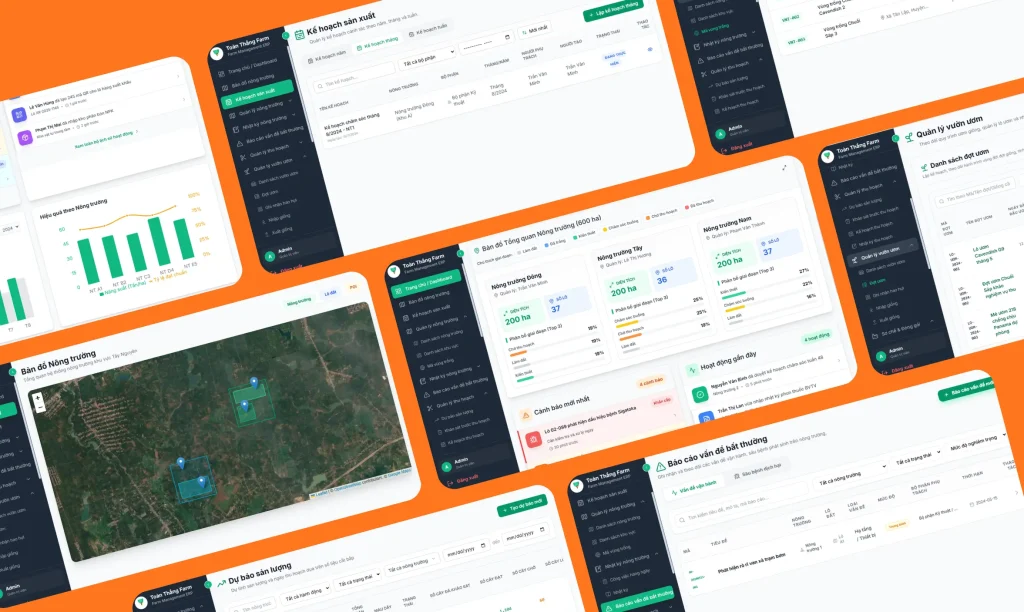
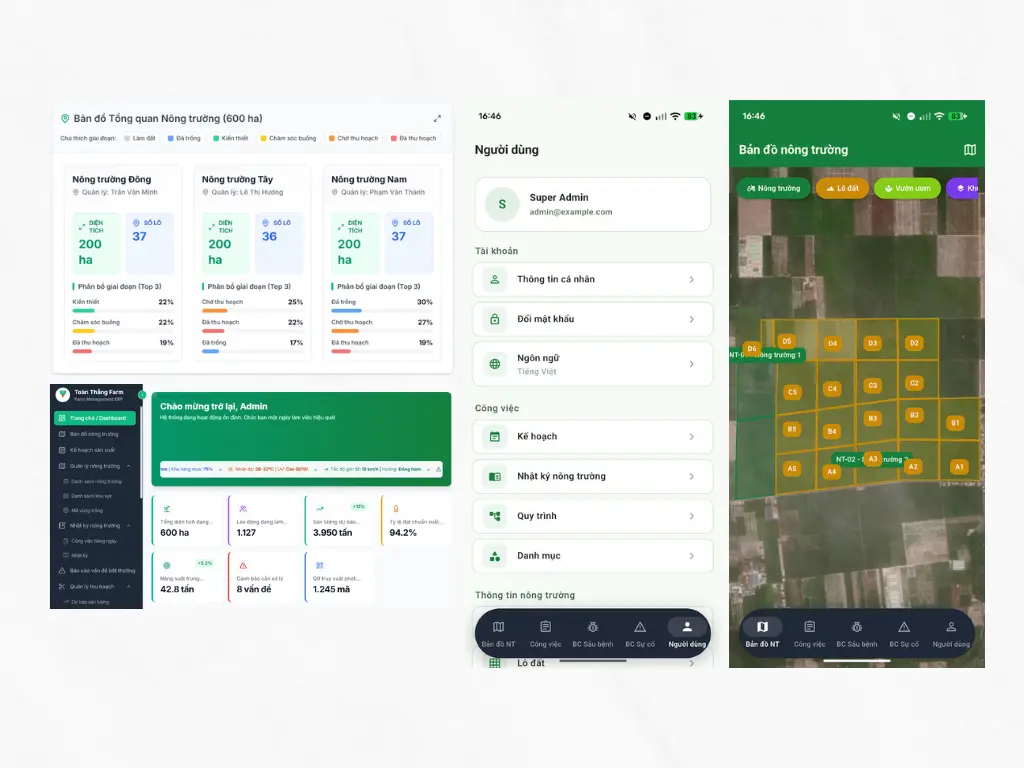
That is where Synodus came in. Instead of simply digitizing existing processes, the team set out to build a centralized Farm Management System that could bring together planning, field operations, materials, labor, harvesting, processing, packing and traceability – while leaving room for the business to evolve toward IoT, automation and AI.
Project goal:
Build a scalable digital foundation that can standardize farm operations today, connect data across the production cycle, and support growth toward a 2,600-hectare operation.
About our client
Toàn Thắng Smart Farm is building a large-scale agricultural operation with the ambition of applying technology as part of the business from the beginning.
The company chose to establish its digital operating foundation while the farm was still taking shape, rather than digitizing years of fragmented processes later. The intention was to help employees adopt digital workflows early, capture operational data consistently and create a foundation for future analysis and automation.
The Farm Management System is therefore not being treated as a standalone internal tool. It is being developed as part of the company’s longer-term operating model.
| Industry | Manufacturing, Agriculture |
| Country | Vietnam |
| Service | Software Delivery (Website development, Mobile App development) |
Business context: Building the digital foundation from Day One
The business challenge was bigger than replacing paperwork.
Farm operations generate information across planting areas, production plans, daily work, materials, labor, nurseries, harvesting, processing, packing, quality and traceability. When those activities are managed through fragmented data, manual reporting and individual experience, it becomes difficult to understand how one part of the operation affects another.
Management needs to answer practical questions quickly: How is each area performing? Is work following the required SOP? How much material and labor has gone into a particular block? Can a finished product be traced back to its source and production history?
There is also a knowledge problem. Agricultural engineers make many decisions based on experience and changing field conditions. The FMS helps capture that operational knowledge in a structured system rather than leaving it only with the people who currently hold it.
The result is a data chain that connects:
Field / Block → Harvest Lot → Packing Lot → Carton → Pallet
The connected data foundation supports day-to-day management, quality control, traceability and future data-driven decision-making.
Project workflow
Toàn Thắng is building its farming operation while its processes are still evolving. Synodus therefore started with the workflows the business needs to manage reliably today, then designed the platform so more advanced capabilities could be added as the operation matures.
| Phase | Scope | Timeframe |
|---|---|---|
| Operational foundation | Farm and crop management, production planning, SOPs, work logs, materials and inventory, labor, nursery, harvesting, processing and packing | Phase 1 |
| Traceability & reporting | Quality management, end-to-end traceability, dashboards and reporting | Phase 1 |
| Data foundation | Standardized operational data and workflows | Phase 1 |
| AI, IoT & monitoring | AI-assisted analysis, IoT, cameras and environmental data | Later phases |
| Automation & optimization | Analytics, forecasting and operational optimization | Later phases |
| Sustainability | ESG, sustainability and future carbon certification data | Later phases |
This sequence was deliberate. At the beginning of the project, the available data was still relatively limited and not fully standardized. Establishing consistent processes and data structures first gave the business a more reliable base for future AI and analytics.
The same principle shaped the architecture: the system needed to support multiple farms, evolving workflows and future integrations without requiring the core platform to be rebuilt each time the business changes.
Solution
Synodus approached the Farm Management System by starting with the farm itself.
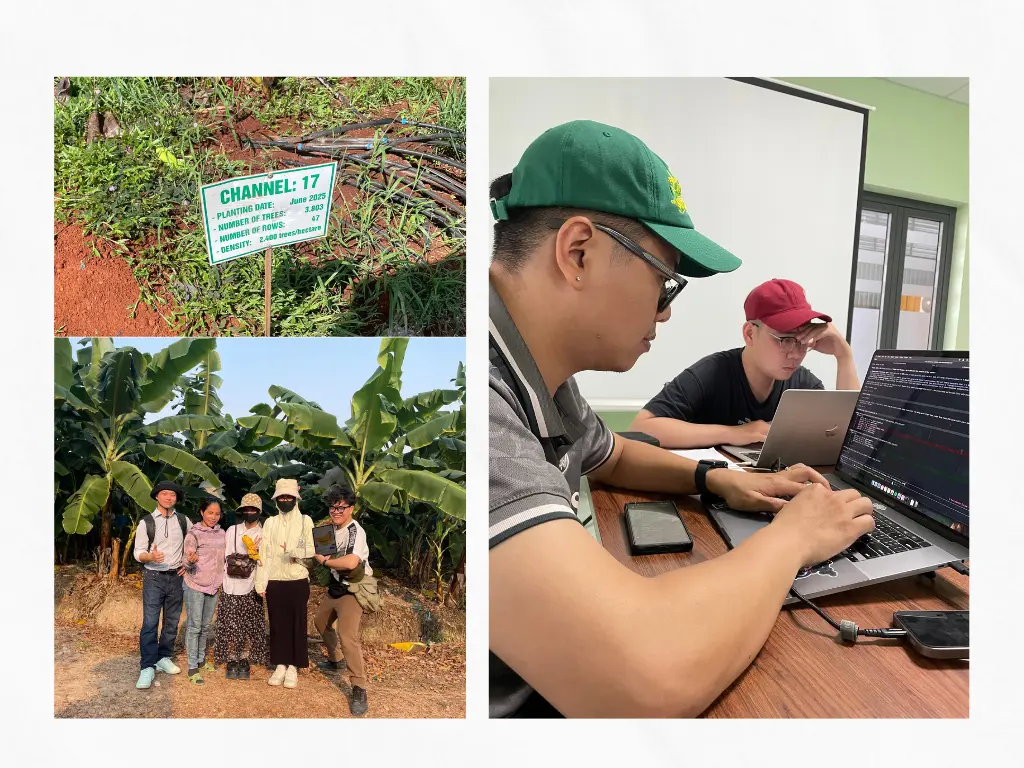
Before designing the product, the team went onsite in Tây Ninh and Cambodia to understand how the operation worked in practice. They observed users, spoke with agricultural engineers and compared real workflows with what could be captured in formal requirements.
The FMS was then designed as a centralized platform covering the core operational cycle, from planning and field activities through harvesting, processing, packing, traceability and reporting.
Rather than trying to automate everything from the beginning, the team focused first on creating a reliable operational and data foundation. At the same time, the platform was designed to evolve with the business and accommodate future IoT, camera, automation and AI capabilities.
Process
Field-first product discovery
The team began by learning how the work was actually done.
Before visiting the farms, they researched banana cultivation so they could ask more useful questions onsite. The visits revealed how users really worked, how agricultural engineers made decisions and where actual workflows differed from documented requirements.
As the CEO of Toàn Thắng Smart Farm shared:“Sometimes there’s something I want to do, but I just don’t know how to express it.”
That is why observation became an important part of the product process.
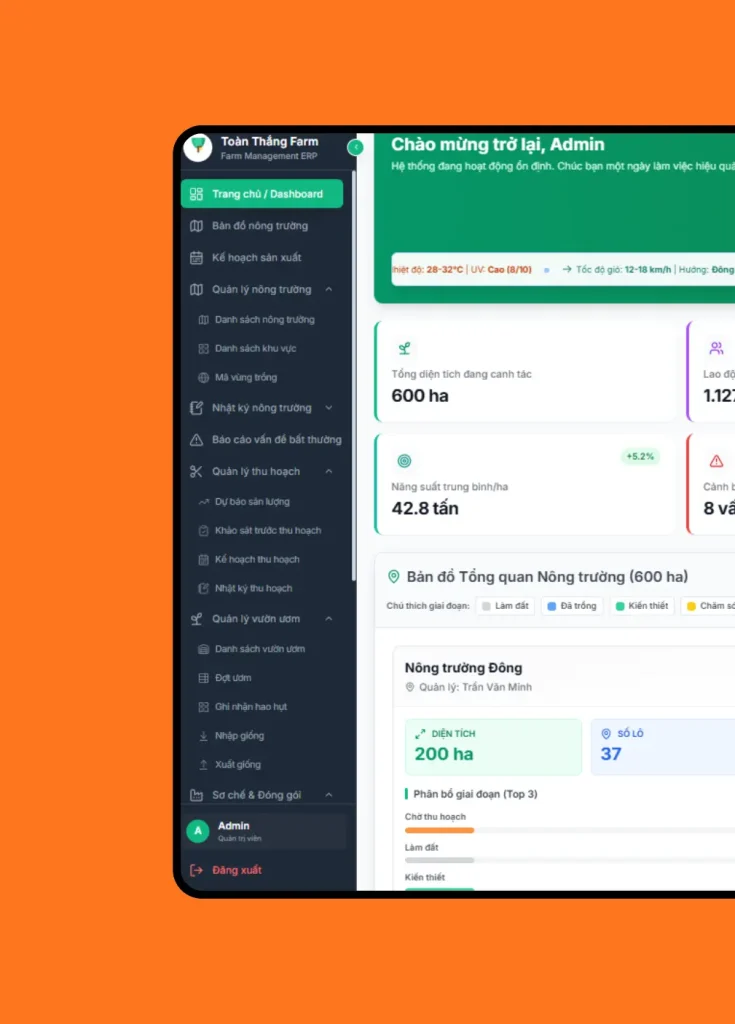
During one onsite visit, the team noticed users repeatedly dragging the screen horizontally to find information. The issue had not appeared as a formal requirement. After seeing the workflow firsthand, the team redesigned the interface so the critical information could fit within a single view.
The same principle continued through workshops, user interviews, pilot activities and Fit/Gap analysis, allowing the team to refine the product based on real usage.
Standardized operations, without ignoring field reality
Agricultural operations require structure, but they cannot always follow the same fixed sequence as a factory.
Banana growth depends on factors such as terrain, sunlight, wind, temperature and plant condition. Agricultural engineers also rely on experience and observation when deciding how and when certain activities should be carried out.
The FMS therefore focuses on standardizing the parts of the operation that need consistency while leaving room for field-level judgment.
| The system standardizes | The field still requires judgment |
|---|---|
| Production plans | Plant condition |
| SOPs | Weather |
| Work logs | Terrain |
| Materials and inventory | Growth variation |
| Labor and tasks | Fertilization decisions |
| Harvest and packing records | Field-specific actions |
| Quality and reporting | Agricultural expertise |
The goal is not to force agriculture into a rigid workflow, but to create enough structure for the business to operate consistently at scale.
A scalable platform for a growing business
The current operation is around 800 hectares, with future expansion expected toward 2,600 hectares. At the same time, some processes and infrastructure are still being developed.
That made scalability more than a technical requirement. The platform needed to accommodate changing farm structure, workflow and future operation without requiring the core system to be rebuilt every time the business changes.
Synodus therefore designed the FMS as a scalable product rather than a one-off custom application, with support for multiple farms and organizational structures through one connected platform.
Data foundation before AI and automation
AI, IoT, camera monitoring and advanced analytics are part of the longer-term roadmap, but they were not treated as the starting point.
At the beginning of the project, the available data was still relatively limited and not fully standardized. Building advanced data and AI capabilities before the operational foundation was ready would have added complexity without giving the business a reliable base to work from.
The team therefore prioritized the core FMS first: digitizing operational workflows, creating consistent data structure and establishing the traceability chain.
The planned progression is:
| Operational foundation → Connected operations → Optimization → Sustainability |
This creates a path toward IoT integration, environmental monitoring, forecasting, automation, AI-assisted analysis and sustainability reporting.
Technology stack
- Backend: NestJS on Node.js / TypeScript
- Database: PostgreSQL, Redis
- Web: React
- Mobile: Flutter for iOS and Android
- Integration: API-based architecture for future external systems
The technology supports one centralized platform that can evolve as the farm expands and new digital capabilities are introduced.
Outcomes
The first phase of the Farm Management System has established the digital foundation for managing a growing farming operation through one centralized platform.
→ Unified operations. Core processes across crop management, planning, SOPs, work logs, materials, labor, harvesting, packing, quality and reporting are being brought into one system.
→ End-to-end traceability. Operational data is connected from Field / Block → Harvest Lot → Packing Lot → Carton → Pallet.
→ Scalable architecture. The FMS is designed to support multiple farms, evolving workflows and future expansion without rebuilding the core platform.
→ Foundation for advanced capabilities. Standardized operational data provides the base for future analytics, IoT, automation and AI-assisted decision-making.
At this stage, verified post-implementation metrics for productivity, cost reduction or operational efficiency are not yet available.
Next steps
Synodus will continue developing the FMS as Toàn Thắng Smart Farm expands its operations and digital processes.
The next phases will focus on:
- Connected operations, including IoT, camera systems and environmental monitoring.
- AI and automation, using standardized operational data for analytics, forecasting and operational optimization.
- Sustainability, extending the data foundation toward ESG, sustainability and future carbon certification requirements.