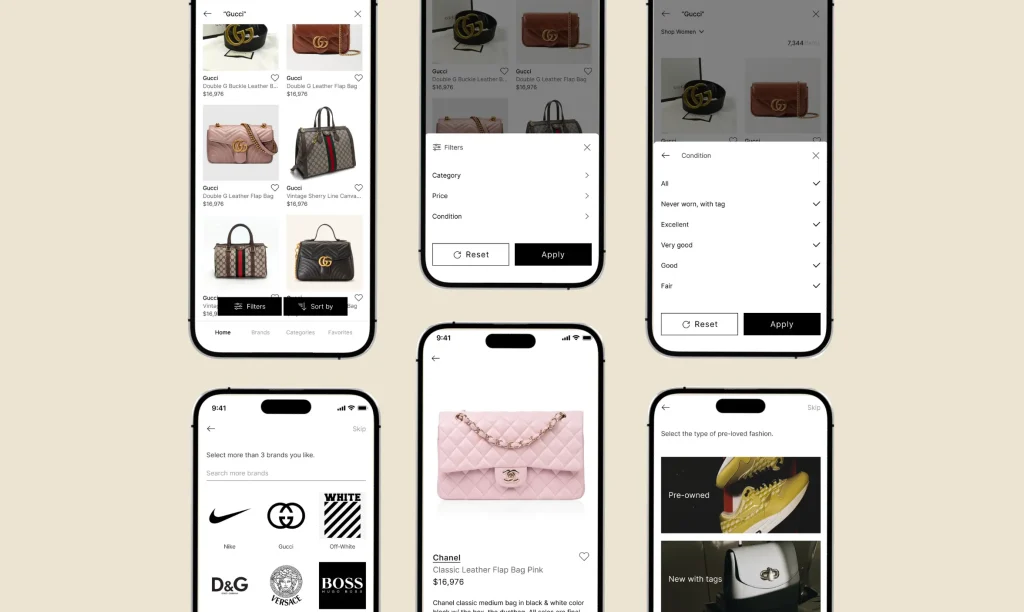
We partnered with a client targeting the luxury fashion segment of the Retail industry. They had been witnessing the shoppers struggle through the fragmented world of luxury resale like opening dozens of tabs, comparing prices, and verifying authenticity across countless global websites. Therefore, they wanted to build a platform that acted as a single search engine for pre-loved luxury fashion. And they wanted it to be a powerful one that could centralize thousands of products from global sources into one clean, seamless interface. We were brought in to turn that vision into a reality.
The challenges we faced
The project started with a reality check. We were dealing with a massive amount of data, and it was chaotic. Some vendors were modern, sending data through real-time APIs, while others were relying on old-school CSV or XML files. Our client needed a system that could handle this inconsistency without forcing those vendors to change their ways.
On top of that, the revenue logic was a major challenge. Because the platform operates as an affiliate aggregator, we had to build an attribution engine that could handle different commission models, whether tied to clicks or successful sales, across different cookie tracking windows. If we couldn’t track every single click accurately, we wouldn’t just be losing data, we would be losing revenue.
How we built the solution
With a team of 5, we decided to build a custom middleware layer rather than relying on off-the-shelf tools. We used NodeJS for the backend to handle the heavy lifting and ReactJS for the frontend to ensure the user experience stayed fast and intuitive.
We engineered an automated ETL architecture that functions as a translator, enabling structured processing through our data analytics capabilities. It ingests the raw, messy data from any vendor and automatically maps it into a standardized format. This allowed us to build a Smart Aggregation Engine that syncs thousands of SKUs in real-time, grouping identical items so users can compare prices instantly.
To handle the revenue side, we built a dedicated tracking module. Every time a user clicks a product, we attach a unique Tracking ID. Even when vendors send us reports days or weeks later, our system automatically reconciles those sales against our records, ensuring every cent is accounted for.
What the team achieved
The results were exactly what our client needed. We managed to hide all that backend complexity behind a clean, unified interface. Customers now have a seamless shopping experience where they can search for a specific item and see all market options in one place.
For the team, we successfully built a system that scales, one where new vendors can be onboarded in hours instead of weeks. Also, we put the entire operation on auto-pilot, replacing manual data entry with automated syncing and revenue tracking. This allowed our client to stop wasting time on spreadsheets and focus entirely on growing their business.
This project was a true test of how custom engineering can turn a fragmented industry into a streamlined, profitable ecosystem. We are proud of how we took a complex problem and transformed it into a scalable asset for our client.
How useful was this post?
Click on a star to rate it!
Average rating / 5. Vote count:
No votes so far! Be the first to rate this post.