Stream the full session
Click here to watch the full episode, see the live workflows and Q&A.
Brought to you by
Synodus is a software engineering company based in Vietnam, specializing in banking & finance, healthcare, and the public sector. We help organizations deliver mission-critical systems by combining strong domain understanding, disciplined delivery, and pragmatic AI adoption – focusing not just on building software faster, but on building the right software with confidence and trust.
In this episode
95% of organizations see zero P&L impact from AI. What are the other 5% doing differently?
In 2024, adoption is no longer the metric – 90% of developers already use AI daily (report by DORA). Yet, Cong Nguyen (Founder & CEO, Synodus) opens with a stark reality check: we are facing a “GenAI Divide” dilemma. While individual productivity feels higher, team stability and throughput are stalling for the majority.
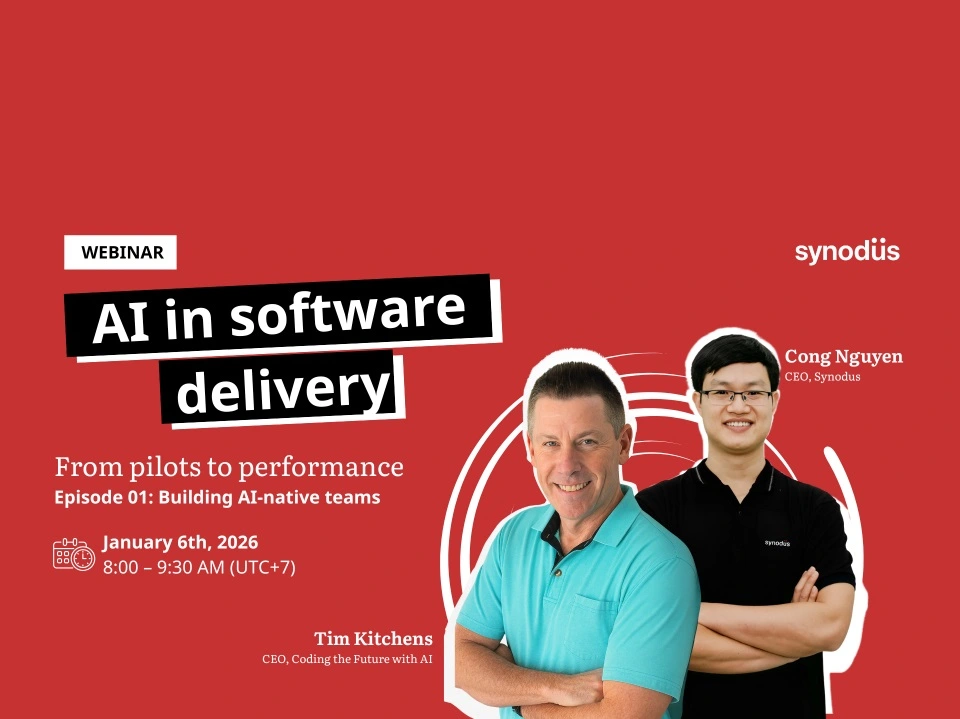
In this kickoff session, we are joined by Tim Kitchens, a veteran software architect with over 30 years of experience. Tim is the CEO of Coding the Future with AI and currently serves as Co-lead of the AI Center of Excellence at PBS (National Public Media), where he guides AI governance across engineering, legal, and HR for hundreds of member stations. Tim breaks down why the old “human-centric” workflows fail in the AI era and introduces the Two-Lane Operating Model – a blueprint for separating innovation from delivery to ensure reliability.
We also feature a live case study from Nguyet Duong (BA Lead, Synodus), who demonstrates how AI-assisted Discovery cut requirement gathering time by 50% and reduced design effort by 30% in a real-world aviation project.
Watch the full episode to see the detailed frameworks, the live coding demos, and the roadmap to AI consistency.
Interesting sections from the episode
1. “AI Paradox”: Why faster coding is leading to slower delivery (starting at 11:46)
By Cong Nguyen
Cong opens with a reality check on the 2025 landscape. The data reveals a split between “feeling productive” and “being productive.”
- Paradox #1: Feeling better but not shipping better. AI clearly improves the individual experience – productivity and flow are up. But actual value work is not necessarily shipping faster.
- Paradox #2: Better local process, worse global delivery. Our data shows throughput dropping by ~1.5% and stability dropping by ~7.2% in high-adoption teams. Why? Because AI increases ‘change size’. Teams are violating small-batch principles because generating code is too easy. AI doesn’t fix a broken system – It exposes weaknesses.
2. “Inconsistency” Trap: Why humans survive inconsistency, but AI collapses (starting at 19:30)
By Tim Kitchens
Tim identifies the single biggest blocker to scaling AI: the belief that developers can keep their own “style”.
I realized how much ambiguity and inconsistency teams quietly tolerate. Humans can fill in gaps, ask around, remember context, or improvise. But AI collapses under that.
When you have vague artifacts… you get very unpredictable results. When you have a clear, consistent structure, you get reliable AI behavior… The single biggest blocker I see is the belief that everyone can continue working the way they always have – choosing their own tools and ‘styles’. Old habits simply don’t scale in the AI era.
3. Solution: The “Two-Lane Model”: Preventing burnout and chaos (starting at 23:05)
By Tim Kitchens
How do you innovate without risking your core business? Tim introduces a mental model for governance.
- The Delivery Lane: If it matters to your business if you get it wrong (financial reports, production code), that is delivery. That is not a place for experimentation. It looks like guided, repeatable workflows with humans-in-the-loop.
- The Innovation Lane: We need to innovate. So, Tim recommends a separate Innovation Lane – a sandbox for folks… [where we] deliberately incorporate lessons learned back into the Delivery Lane.
- Outcome: Mature teams using this structure see 10X feature delivery speed and Onboarding times dropping from weeks to hours because new developers rely on embedded AI context, not tribal knowledge.
Live Technical Demo: Stopping the “Vibe Coding” (starting at 27:09)
By Tim Kitchens
In a counter-intuitive move, Tim demonstrates why you shouldn’t use GenAI for everything. He walks through a workflow using Python Cookie Cutter (Deterministic) combined with Claude Code (Generative).
“If you can make it deterministic, my vote is that – you do. Don’t use GenAI to guess your project structure. Use rigid templates (scaffolding) to enforce the rules, then invite the AI in to write the logic. This is how you guarantee reliability.”
BA Case Study: From “Vague Idea” to “Prototype” in Minutes (starting at 50:43)
By Nguyet Duong
The bottleneck often isn’t coding – It’s understanding the requirement. Nguyet demonstrates an aviation project (CPMS). In this case study, she shares how BAs are shifting from “gathering requirements” to “structuring context”.
Traditionally, it took me 3 days to read requirements and nearly 2 weeks to build an initial demo. With clear guardrails, I used AI to generate a structured Design Brief and turn it into a clickable prototype within minutes. But AI isn’t magic – it’s an amplifier of both strengths and weaknesses. I never treat outputs as validated requirements. They’re thinking of artifacts to surface assumptions, unknowns, and constraints. The prototype anchors better conversations, helping me understand clients faster and co-design solutions with them – while trust comes from validating what we don’t know together.
Timestamps
(08:40) Intro
(10:24) 2025 GenAI in Software Engineering: High adoption, Mixed Results
(11:46) #1 Paradox – Feeling better, Not shipping better
(13:21) #2 Paradox – Better process, Worse delivery
(14:10) The “GenAI Divide”: Why only 5% of companies are seeing P&L impact.
(15:13) The Core Problem in 2025 and Reframing the Question in 2026
(16:38) Keynote: Tim Kitchens
(19:30) The reality today: “My Style” Trap
(21:50) Why structure matters
(23:05) The Two-Lane Model
(24:35) What AI-Native Workflows look like
(25:31) When AI shouldn’t lead
(26:22) One workflow, Many leverage points
(27:09) Live Technical Demo (Deterministic Scaffolding + AI Coding)
(41:15) Training through AI itself
(42:53) The Roadmap: Learn first, Scale intentionally
(45:33) Beyond engineering (HR, Ops, Marketing)
(46:04) How to start (A Practical Roadmap)
(50:43) Case Study: Practical AI for Business Analysts (From vague idea to clickable prototype)
(1:26:50) Q&A
References
Connect with the Speakers:
- Tim Kitchens: LinkedIn Profile
- Cong Nguyen: LinkedIn profile
Resources mentioned:
- 2025 State of AI-assisted software development by DORA
- METR RCT (early-2025)
- MIT, Project NANDA 2025
Next Episode:
We’re hosting next session of our AI in Software Delivery series with Christian Runge from SimCorp.
This one goes deep into how engineering leaders measure AI impact beyond speed, and what mean in real workflows like code generator and review.
Date & Time: Thursday, January 22, 2026 | 14:00 – 15:30 PM (UTC +7).