What is NFT staking?
NFT staking is the process of committing an eligible non-fungible token to a staking contract, platform, or project-defined mechanism for a period of time in exchange for rewards or additional utility.
The NFT holder does not need to sell the asset to participate. Depending on the staking model, however, the NFT may be transferred into a smart contract while it is staked, which can prevent the holder from selling or transferring it until it is unstaked.
Not every NFT can be staked. The collection or a third-party protocol must support a staking mechanism for that specific NFT, and the rules can differ considerably between projects.
Rewards can also take several forms. A project might distribute its native token, increase an NFT’s in-game utility, grant governance rights, provide access to gated experiences, or tie rewards to other activity within its ecosystem.
NFT staking vs crypto staking
The similar terminology creates one of the biggest misconceptions around NFT staking.
| NFT staking | Proof-of-stake crypto staking | |
|---|---|---|
| Asset | NFT | Fungible cryptocurrency |
| Typical purpose | Rewards, utility, retention, governance, gaming | Blockchain security and consensus |
| Validator role | Usually none | Validators or delegators participate in network consensus |
| Rewards | Tokens, utility, access, governance, ecosystem benefits | Protocol staking rewards |
| Availability | Only supported NFTs/projects | Tokens supported by the PoS network |
| Rules | Project-specific | Defined by the blockchain protocol |
In conventional Proof-of-Stake networks, participants commit cryptocurrency to help secure and operate the blockchain. Validators can participate in proposing or confirming blocks and receive protocol rewards for doing so.
NFT staking normally operates one layer above that. The NFT is committed to a project-specific contract or protocol, and rewards follow rules created by that project rather than the blockchain’s consensus mechanism.
There are exceptions. KIRA’s Multi-Bonded Proof of Stake architecture is designed to allow governance-approved NFTs alongside tokens, real-world assets, LP tokens, and other assets to be used as staking collateral for network security. That is a specialized consensus architecture, not how NFT staking generally works.
How does NFT staking work?
The exact process depends on the project, but a common NFT staking flow looks like this:
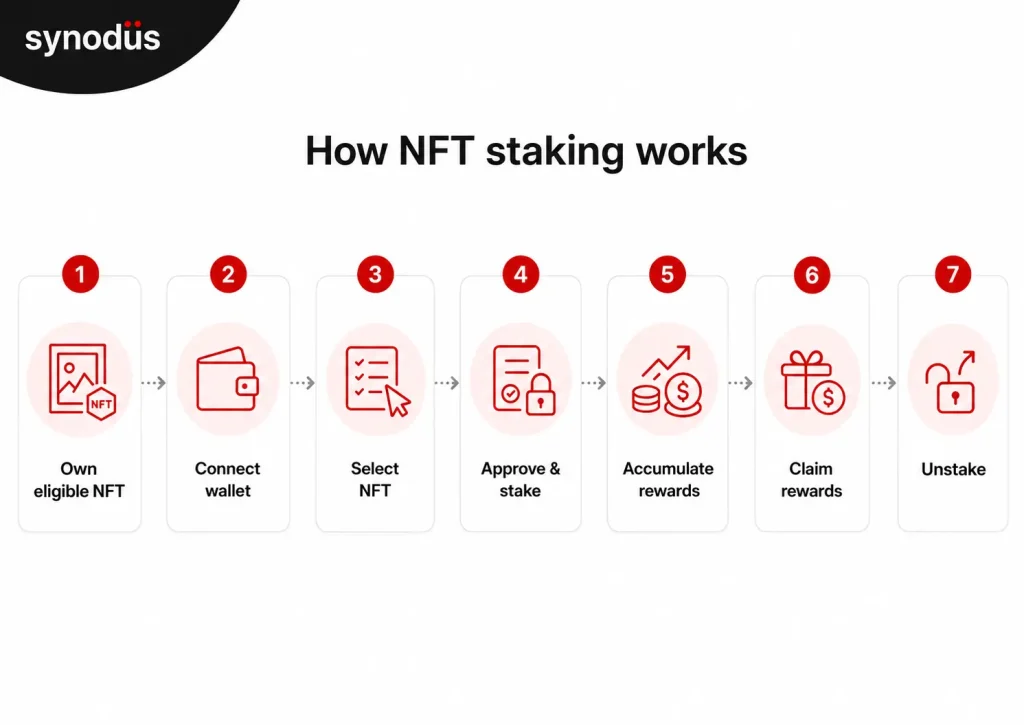
First, the holder needs an NFT that is eligible for the staking program. Simply owning an NFT does not mean it can be staked, so eligibility and current staking rules should be checked with the project before taking any action.
The user then connects a compatible wallet and approves the staking contract to interact with the NFT. In a custodial staking model, confirming the staking transaction transfers the NFT to a smart contract until it is unstaked.
Once staked, the NFT begins accumulating whatever rewards the program defines. Rewards may accrue continuously, at fixed intervals, according to an activity schedule, or based on a pool-wide calculation.
The holder may be able to claim accumulated rewards without unstaking the NFT, although this varies by contract. When the holder eventually unstakes, the NFT is returned according to the protocol’s rules and any unclaimed rewards may also be distributed.
Some implementations work differently. A project can use non-custodial mechanics, receipt tokens, or other structures that reduce the need to lock the NFT in a traditional staking contract. “Staking” should not automatically be interpreted as one standardized technical process.
What can you earn from NFT staking?
NFT staking is often described as a way to earn passive income, but that description is too narrow. A staking program can provide financial rewards, product utility, community benefits, or a combination of them.
Token rewards
A common model is to distribute a fungible token to NFT holders while their assets remain staked.
The token might be a governance token, game currency, ecosystem token, or another reward asset. Its economic value depends on the token’s demand, liquidity, supply, emissions, and wider project economics, so receiving more tokens does not necessarily mean the user’s position has gained value.
MOBOX provides a clear example. Its documentation describes an NFT yield farming system in which staking MOMO NFTs generates MBOX, with distribution influenced by the holder’s hash power relative to the platform.
Token rewards are separate from creator royalties, which are payments made to original creators on eligible secondary sales rather than rewards for holding or staking.
Governance rights
Some projects use staking to connect longer-term participation with governance. A staked NFT or the rewards earned from it may contribute to voting rights, proposal eligibility, or other governance privileges, but the exact relationship is project-specific and should be verified rather than assumed.
In-game rewards and utility
NFT staking can also be incorporated into blockchain games. Instead of rewarding holders purely for leaving an NFT idle, a game can connect staking with progression, characters, land, resources, boosts, or other gameplay systems.
Axie Infinity currently operates a dedicated Land Staking dashboard alongside its AXS staking interface. The dashboard tracks staked land plots and reward information for different land types.
Access and membership benefits
Staking does not always need to generate a tradable token. Projects can use it to grant access to gated content, events, community channels, tournaments, product features, early releases, or loyalty tiers.
The distinction matters because an NFT staking program should be evaluated based on where its rewards actually come from and what they are useful for, not just the headline reward rate.
How are NFT staking rewards calculated?
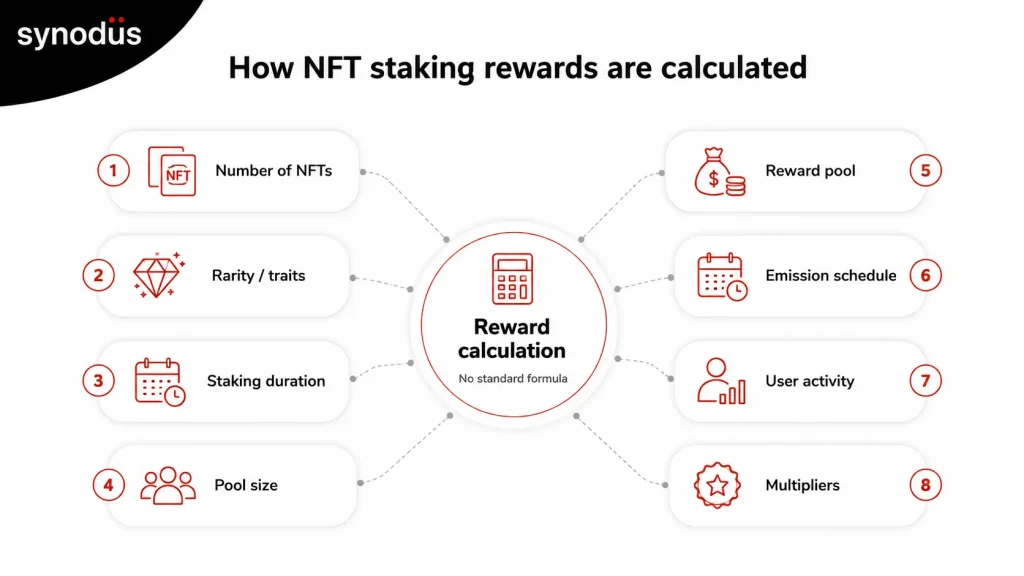
There is no standard NFT staking formula. One project may reward every eligible NFT equally, while another assigns different weights based on rarity, traits, staking duration, gameplay activity, or another project-specific metric.
- Number of NFTs staked
- NFT rarity or specific traits
- Length of the staking period
- Total number or weight of NFTs in the pool
- Available reward pool
- Reward emission schedule
- User or in-game activity
- Project-specific multipliers
MOBOX illustrates a trait-weighted approach. Each MOMO has hash power, and the user’s combined hash power affects their share of MBOX distributed through its NFT yield farming system.
Uniswap v3 provides a different example. Eligible Uniswap v3 position NFTs can be deposited into a staking contract and participate in incentive programs associated with the underlying liquidity position.
APR or APY figures should be interpreted carefully. A percentage return denominated in a project’s reward token does not guarantee an equivalent return in dollars because the reward token and the staked NFT can both change in value.
A very high advertised return can also be misleading if rewards come primarily from aggressive token emissions. As more tokens enter circulation or demand falls, the value of those rewards can decline even while the nominal number of tokens earned remains high.
Benefits and risks of NFT staking
NFT staking can add another use case to an NFT, but it does not automatically make an NFT valuable or make a project sustainable. The potential benefits should be evaluated alongside the additional risks created by locking an asset into another protocol.
Potential benefits of NFT staking
Use an NFT without immediately selling it. A holder can participate in a project’s reward or utility system while retaining their economic interest in the NFT.
Add utility to an NFT collection. Staking can give an NFT a purpose beyond holding or trading, particularly when rewards connect to gameplay, membership, governance, or ecosystem activity.
Encourage longer-term participation. Projects can reward users who remain active in the ecosystem instead of relying entirely on speculative buying and selling.
Participate in governance or community systems. Where supported, staking can connect NFT ownership with voting rights, access privileges, loyalty programs, or other forms of participation.
Staking may temporarily reduce the number of NFTs available for sale when assets are locked in contracts. However, that does not guarantee that the collection’s price will rise because market demand, liquidity, project performance, and broader market conditions still determine prices.
Risks of NFT staking
- Price volatility: The market value of the NFT can fall while it is staked, and a lock-up may prevent the holder from selling quickly.
- Reward-token value: A large number of reward tokens does not necessarily produce a profitable return if the reward asset loses value.
- Smart contract vulnerabilities: Bugs, exploits, incorrect permissions, or other vulnerabilities can potentially make NFTs or rewards inaccessible or lead to loss.
- Liquidity and lock-up: Some staking programs prevent users from transferring or selling NFTs during the staking period.
- Reward sustainability: Programs funded mainly through token issuance can offer attractive early rewards without a sustainable long-term source of value. For more on how marketplace revenue models work, see our NFT marketplace business model guide.
- Project and platform dependency: Staking depends on the project continuing to maintain contracts, interfaces, rewards, infrastructure, and the utility that gives those rewards value.
NFT staking should be treated as participation in a project-specific incentive system, not as guaranteed interest on an asset.
NFT staking examples
The term NFT staking covers several different models. Looking at current examples is more useful than assuming every platform follows the same lock-and-earn structure.
MOBOX: NFT yield farming
MOBOX uses MOMO NFTs as part of its GameFi ecosystem. Its documentation describes a yield farming mechanism in which MOMOs contribute hash power and users farm the MBOX governance token based partly on their weighted share of total platform hash power.
MOBOX also documents that newly acquired MOMOs can be automatically staked for mining while remaining usable in games. Staking mechanics adapted around product utility rather than requiring every NFT to sit idle is a useful model for gaming-oriented projects.
Axie Infinity: Land staking
Axie Infinity provides another gaming example through its Land Staking system. Its current staking dashboard supports land plots such as Savannah, Forest, Arctic, Mystic, and Genesis and displays staking and reward information by land type.
The staking opportunity belongs to a specific game ecosystem, so users need to evaluate the NFT, the staking reward, and the ongoing role of land inside Axie’s economy together rather than treating yield as an isolated investment.
Land staking and AXS staking are also not the same thing. AXS is a fungible token, whereas Land staking involves NFTs. The same ecosystem can support both mechanisms without them being the same type of staking.
Uniswap v3: Position NFT staking
NFT staking is not limited to gaming and collectibles.
Uniswap v3 liquidity positions are represented as NFTs. In its liquidity mining architecture, users can deposit an eligible position NFT into the canonical staking contract and participate in incentive programs associated with the underlying liquidity position.
The NFT here represents a financial position, and the reward is connected to the economic function of that position, not to collecting or gameplay. NFT describes the token format, not the economic purpose of the asset, and staking models need to be understood in that context.
KIRA: NFTs as potential staling collateral
KIRA is a useful special case because it blurs the line between NFT staking and conventional blockchain staking.
KIRA’s Multi-Bonded Proof of Stake model is designed to allow different governance-approved assets, including NFTs, cryptocurrencies, real-world assets, LP tokens, and stablecoins, to serve as staking collateral. In this case, staking is tied to network security rather than only project-level rewards.
KIRA should not be used as the general model for explaining how NFT staking works, but it shows that specialized architectures can give NFTs a role in blockchain consensus.
How to evaluate an NFT staking opportunity
The headline reward rate should not be the first thing you evaluate. Start by understanding what happens to the NFT, where the rewards come from, and whether the reward mechanism makes economic sense.
1. Confirm that the NFT is eligible
Not all NFTs from a project are necessarily stakeable. Verify the eligible collection, token standard, network, staking contract, and official staking interface before buying or committing an NFT specifically for staking.
2. Understand what happens to the NFT
Check whether staking transfers the NFT into a smart contract, leaves it in your wallet, or uses another mechanism. If the contract takes custody, determine whether the NFT can be unstaked whenever you want and whether an enforced lock-up or cooldown applies.
Also check whether staking prevents the NFT from being sold, transferred, rented, or used elsewhere.
3. Understand where the rewards come from
Rewards might be funded through token emissions, a project treasury, game-economy activity, marketplace or protocol revenue, transaction fees, or another project-specific source. A reward funded mainly by newly issued tokens behaves differently from one tied to actual economic activity.
4. Evaluate the reward asset
Do not evaluate returns only by the number of tokens earned. Ask whether the reward token has liquidity, what it can be used for, how its supply changes, and whether significant new emissions are entering circulation.
5. Check how rewards are calculated
Find out whether returns depend on NFT rarity, traits, duration, total pool size, user activity, or another weighting model. Also check whether a displayed APR or APY is fixed, variable, estimated, or derived from current conditions.
6. Review contract and platform risk
Use the project’s official staking interface and confirm contract addresses where possible. Look for security reviews or audits, but do not treat an audit as a guarantee because contract permissions, upgradeability, operational controls, and later modifications also matter.
7. Consider the opportunity cost
Ask what you give up by staking. If the NFT becomes locked, you may lose the ability to sell during a market move or use it elsewhere in the ecosystem. The staking reward needs to be considered against that reduced flexibility.
A useful decision framework: Expected reward value – staking costs – opportunity cost – additional risk
Even then, the result remains uncertain because both the NFT and reward asset can change in value.
Can NFT staking be added to an NFT marketplace?
Yes, but NFT staking should be treated as an optional ecosystem feature, not a basic requirement of every NFT marketplace. A general marketplace primarily needs to help users discover, list, buy, sell, and manage supported assets.
Staking becomes relevant when the marketplace or associated project has a reason to reward holding, gameplay participation, governance, loyalty, or another form of longer-term engagement.
When staking is added, the marketplace typically needs:
- NFT eligibility rules
- Staking and unstaking contracts
- Reward calculation logic
- Stake, unstake, and claim interfaces
- Reward balances and history
- Lock-up or cooldown logic
- Admin controls
- Analytics and monitoring
- Integration with game, membership, DAO, or other ecosystem systems
The technical model also depends on whether NFTs are transferred into custody, remain usable while staked, and how rewards are funded. Theta’s NFT staking dApp demo illustrates a contract architecture with staking, reward calculation, claiming, and unstaking functions, while also recommending additional backend infrastructure and contract auditing for production use.
For a broader view of where staking fits alongside other marketplace functionality, see our NFT marketplace features guide. If staking is part of a larger marketplace product, our guide to building an NFT marketplace covers the wider development process.
Final thoughts
NFT staking gives projects a way to connect NFT ownership with rewards, utility, governance, gameplay, or other forms of participation. Unlike Proof-of-Stake crypto staking, it usually does not contribute to blockchain consensus and should instead be understood as a project-specific incentive mechanism.
Whether staking is worthwhile depends on much more than the advertised reward rate. NFT value, reward-token economics, lock-up conditions, contract security, opportunity cost, and the source of the rewards all matter, and the rules can vary significantly from one project to another.
For marketplace operators, the same principle applies. NFT staking can be a useful feature when it serves a clear ecosystem purpose, but adding staking simply to advertise another source of passive income can create token-economic and security complexity without improving the marketplace itself.