What is NFT mingitng?
NFT minting means creating a new non-fungible token on a blockchain. The process records the token according to a smart contract, assigns it a unique identity within that contract, and establishes the first owner of the NFT.
The underlying media does not always have to be stored directly on-chain. In many implementations, the NFT points to metadata that describes the asset, while the smart contract controls ownership, transfer rules, and other token behavior.
Minting creates the token record, not necessarily the image, video, game item, or document itself. Depending on the architecture, the media and metadata may be stored on-chain, on decentralized storage such as IPFS, or on another storage layer referenced by the token.
A typical NFT includes a token ID, a smart contract address, an owner address, and metadata that describes the represented asset. Together, the contract address and token ID uniquely identify the NFT within its blockchain ecosystem.
How does NFT minting work?
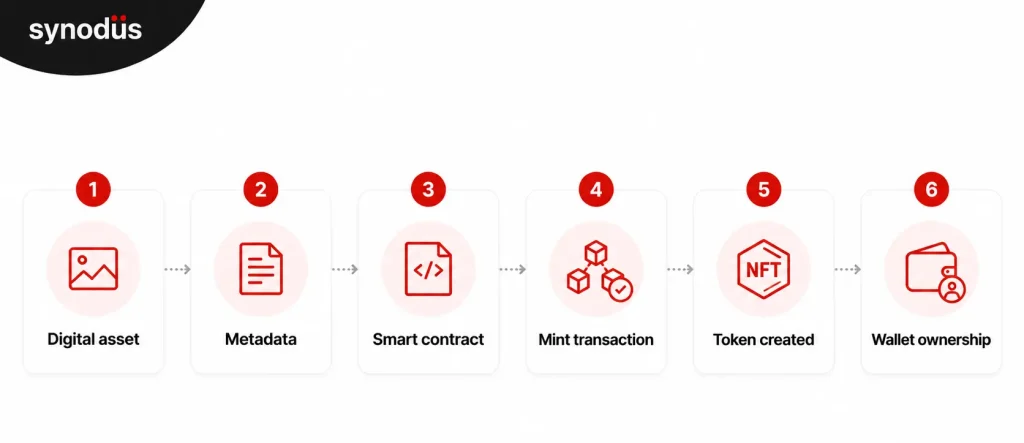
The exact minting flow varies by blockchain, token standard, and product design, but the underlying mechanism is consistent: a smart contract defines how tokens are created and owned, and a mint transaction is the event that brings a specific token into existence under that contract.
The smart contract defines the NFT
The smart contract defines how the NFT is created and how ownership is tracked. On Ethereum-compatible networks, ERC-721 is commonly used for unique NFTs, while ERC-1155 can support both fungible and non-fungible token types within one contract.
The contract may also contain rules for supply, mint permissions, royalties, allowlists, reveal mechanics, transfer restrictions, or other project-specific behavior. These rules should be designed before minting begins, because mistakes in a deployed contract can be difficult or costly to correct.
Marketplaces and applications index the NFT affer minting
After minting, marketplaces and wallets usually need to retrieve the NFT’s contract data and metadata before displaying it correctly. This indexing layer is separate from the act of minting itself, which is why a successfully minted NFT may not always appear instantly on every interface.
For a marketplace product, the post-mint experience matters as much as the blockchain transaction. Metadata parsing, image retrieval, trait indexing, ownership updates, and collection discovery all affect whether the NFT is actually usable once it has been created.
NFT minting vs buying vs listing
Minting, buying, and listing get used interchangeably, but each one solves a different problem in an NFT’s lifecycle. Minting creates the token, buying transfers ownership through a purchase, and listing makes an already-minted token available for sale or trade.
| Factor | Minting | Buying | Listing |
|---|---|---|---|
| Purpose | Create the token | Acquire ownership of an existing token | Offer an existing token for sale or trade |
| Blockchain state | Establishes the NFT | Transfers ownership, no new token created | Creates or signs sale/order logic |
| Ownership | Establishes the initial owner | Ownership moves from seller to buyer | Owner already holds the NFT |
| Marketplace required | No | Usually, via a marketplace or trading protocol | Usually uses a marketplace or trading protocol |
| Main technical focus | Token contract and metadata | Payment, escrow, and ownership transfer | Order, pricing, settlement, and discovery |
The lines blur most at primary sale, where a buyer’s purchase can be what actually triggers the mint, especially with lazy minting. In that case, the transaction looks like a purchase to the user, while under the hood it is both a mint and a transfer happening in one step.
NFT minting methods
How you mint NFTs affects more than when a token appears on-chain. It can influence transaction costs, scalability, user experience, and how much of the process needs to happen upfront. You can mint each token as soon as it’s created, or spread the process out through lazy or batch minting. Choosing the right approach depends on your collection size, sales model, and how you expect users to interact with the NFTs.
Lazy minting
Lazy minting delays the final on-chain mint transaction until a later event, often when the NFT is purchased or claimed. This can reduce the creator’s upfront cost, because a token does not need to be minted on-chain before there is a buyer or recipient.
Lazy minting changes when the token is created and, depending on the implementation, can shift or defer who pays the transaction fee. Blockchain costs still apply somewhere in the process.
| Factor | Regular minting | Lazy minting |
|---|---|---|
| Token creation | Created before sale or transfer | Created later, often at purchase or claim |
| Upfront transaction cost | Usually incurred at mint | Often deferred |
| On-chain token before purchase | Yes | Not necessarily |
| Best fit | Ready collections and direct issuance | Reducing unnecessary upfront minting |
Batch minting
Batch minting creates multiple NFTs within a coordinated process, rather than minting each token manually through a separate user flow. It is useful for large collections, game inventories, tickets, memberships, or enterprise issuance.
The design needs to account for contract limits, transaction size, metadata generation, and indexing volume. A poorly designed batch process can save user effort while still creating avoidable gas or operational costs. See the NFT Minting Example below for how this actually played out on a live game marketplace.
How to mint an NFT
Minting an NFT may look like a single click, but several steps happen behind that action. You need to choose the blockchain, prepare the asset and metadata, connect a wallet, and complete the transaction that creates the token on-chain. Afterward, the NFT still needs to be verified before it can be listed, traded, or used in an application. The details vary between regular, lazy, and batch minting, but the core flow is largely the same.
1. Choose a blockchain
Start by choosing the blockchain where the NFT will exist. The decision affects transaction fees, wallet compatibility, marketplace support, smart contract tooling, performance, and the users who can interact with the asset.
Ethereum remains a major NFT ecosystem, while networks and scaling solutions with lower transaction costs can be attractive for high-volume collections or gaming use cases. The best choice depends on the project’s users, economics, and technical requirements, not on minting cost alone.
2. Prepare the digital asset and metadata
Prepare the media or digital object that the NFT will represent, then define the metadata users and marketplaces need to understand the asset. A simple collectible may only need a name, image, and traits, while a game or RWA application can require a much richer data model.
Decide early whether the metadata should remain fixed or be updateable. That choice affects storage, indexing, smart contract logic, and how reliably marketplaces can display the asset later.
3. Connect a wallet
Most public minting platforms and dApps use a blockchain wallet to identify the user and sign transactions. The wallet becomes the owner of the newly minted NFT unless the smart contract is designed to mint directly to another address.
A custom minting flow may abstract some of this complexity through embedded wallets, sponsored transactions, or account abstraction. Even then, the product still needs a secure way to authorize who is allowed to mint and who receives the token.
4. Submit and confirm the mint transaction
With the method already chosen, the wallet signs the mint transaction and the blockchain processes it (or, for lazy minting, this step is deferred until purchase, as covered above). On networks that charge gas, the amount can vary depending on network conditions and the complexity of the smart contract call.
A successful confirmation means the NFT now exists on-chain under the deployed contract. The token can then be indexed by compatible services and shown in the recipient’s wallet or application.
5. Verify and list the NFT
After minting, verify that the token metadata, ownership, media, and traits are displayed correctly before making the asset available to users. If the NFT is intended for trading, the owner can then list it on a compatible marketplace or interact with a trading protocol.
How much does it cost to mint an NFT?
Minting a single NFT typically costs anywhere from a fraction of a cent to $50 or more, and the blockchain you mint on accounts for most of that gap. The table below shows typical per-mint gas costs by network.
| Blockchain | Typical cost per mint | Notes |
|---|---|---|
| Ethereum mainnet | $5–$50, spiking to $100–$200+ | Cost tracks network congestion closely; peak-demand launches see the highest spikes |
| Polygon | Under $0.01 | Consistently low regardless of congestion, common choice for high-volume drops |
| Solana | Under $0.01 (often under $0.001) | Among the cheapest active NFT chains |
| Arbitrum, Base, Optimism (L2 rollups) | A few cents | Costs fell sharply after Ethereum’s Dencun upgrade reduced Layer 2 data fees |
| Immutable X | Near $0, gasless for NFT mints | Purpose-built for NFTs and gaming, gas cost absorbed by the network’s model |
These figures are gas fees only, for a single, straightforward mint transaction. Three things push the real cost higher or lower:
- Network congestion. Ethereum fees can swing 5–10x between a quiet period and a high-demand launch, since gas price is set by transaction demand at that moment, not by the NFT itself.
- Contract complexity. A mint function with allowlist checks, on-chain royalty logic, or dynamic metadata updates consumes more gas than a minimal mint call. Batch-optimized contract standards such as ERC-721A can cut gas for multi-token mints significantly compared to minting the same NFTs one at a time.
- Who is paying. Direct minting has the creator or collector pay gas at mint time. Lazy minting and gasless/sponsored minting move that cost to a later point, such as the buyer at purchase, or absorb it into the platform’s own economics, which is why a mint can feel free without the underlying transaction cost disappearing.
Two other cost lines sit outside the gas fee itself and are easy to miss when budgeting:
- Smart contract deployment, if you are not minting through an existing platform’s shared contract. A custom contract typically runs from a few hundred to several thousand dollars in development, plus the one-time gas cost to deploy it to the network, plus an audit if the contract will handle payments or high-value assets at scale.
- Marketplace and platform fees, separate from gas. Marketplaces commonly charge a primary sale commission in the 2.5–5% range, on top of whatever gas the mint itself required.
When should you use an NFT minting platform or build a custom solution?
An NFT minting platform provides the interface and infrastructure needed to create NFTs without touching contract code: asset upload, metadata forms, wallet connection, network selection, and the mint transaction itself. That covers most individual creators well, but it starts to break down once minting has to serve a specific business model rather than a one-off collection.
The right approach depends on how much control the project needs. Here are three common ways to set up NFT minting, from using an existing platform to building a custom solution.
| Option | Main advantage | Main limitation | Best fit |
|---|---|---|---|
| Marketplace with built-in minting | Fastest path to create and trade | Limited control over contract, branding, and flow | Individual creators and simple collections |
| Dedicated minting platform | Creator-focused mint workflow, still low setup effort | Constrained by whatever networks and features it supports | Campaigns, drops, and one-off collection launches |
| Custom minting website or dApp | Full control over contract, UX, and integrations | Higher development and security effort | Products where minting logic is part of the business itself |
The first two options remove work: smart contract deployment, wallet integration, and basic minting UX are already built. What they take away in exchange is control over contract rules, branding, and how minting connects to anything else the product needs to do.
A custom minting website earns that extra effort when minting stops being a one-time publishing task and becomes part of the product. That is the case when:
- The minting rules are specific to your business model, not a generic template
- Users need to mint without leaving your product
- The flow needs an embedded wallet or gas-sponsored UX
- NFTs interact with game, membership, loyalty, or RWA systems
- The project requires batch issuance or role-based mint permissions
- Minting needs to connect directly to a custom marketplace
- You need control over metadata, indexing, and post-mint workflows
The stronger reason to build custom is not that it looks more professional. It is that the minting logic itself is part of the product’s competitive or operational requirements, and at that point, an off-the-shelf platform is constraining the product rather than saving time. Once minting reaches that point, the relevant cost question shifts from per-mint gas to development investment, covering the smart contract, wallet integration, indexing, and marketplace layer as a whole. Our NFT marketplace development cost guide breaks that investment down by project scope.
NFT minting challenges in real-world products
Minting a single NFT is relatively straightforward. The complexity starts when minting becomes an ongoing part of a live product, such as a game issuing items, a loyalty program distributing rewards, or a marketplace running regular drops. At that point, problems emerge that a basic “how to mint” guide does not address.
When NFT metadata needs to change
Most minting guides treat metadata as something set once and left unchanged. That works for a one-off collectible, but it becomes limiting for NFTs tied to systems that keep evolving, such as a game character that levels up, a membership that moves between tiers, or an asset whose value or status changes over time.
If the metadata schema was designed with the assumption that the data would remain permanent, adding update logic after launch may require a contract migration rather than a simple fix.
The gap between “minted” and “usable”
A token existing on-chain and being usable inside a product are not the same milestone. Indexing needs to capture every mint event, resolve the correct metadata, and reflect ownership changes reliably. It also needs to keep up with the rate at which the product issues tokens.
A mint that succeeds on-chain but appears incorrectly, late, or not at all inside the application is still a product issue, even if the blockchain layer worked as expected.
Wallet and identity at product scale
A single creator connecting a personal wallet to mint one collection is very different from thousands of users minting inside a consumer app, or a set of authorized accounts minting within an enterprise system.
Once minting is embedded into a product, identity, authorization, and how much blockchain complexity users see all need to be designed deliberately. Embedded wallets, sponsored transactions, or account abstraction can reduce that complexity, but the product still needs a secure way to determine who can mint and who receives each token.
Batch issuance without losing control
Issuing NFTs one at a time does not scale for products that need to create hundreds or thousands of tokens at once, such as game inventories, event tickets, or loyalty drops. Batch minting addresses the throughput problem, but it introduces another requirement: every token in the batch still needs to be individually trackable and accurate.
Contract limits, transaction size, and metadata generation all need to be designed for volume from the start rather than patched later. This becomes especially important in gaming, where a marketplace may need to issue and track large numbers of in-game assets while maintaining visibility into each token. The example below shows how this can play out in a real gaming marketplace.
Cyberium is one example of how these challenges can appear in a live gaming product. Synodus built the NFT marketplace behind Cyberium’s in-game economy, where in-game items had to be minted in bulk while their traits continued to change with player progress. Those two needs pull against each other: batch minting is built for issuing tokens efficiently, while dynamic metadata requires individual tokens to remain updateable after minting. The marketplace’s indexing and metadata-refresh layer had to support both requirements, keeping individual token metadata accurate as the game continued to evolve.
What should a custom NFT minting platform support?
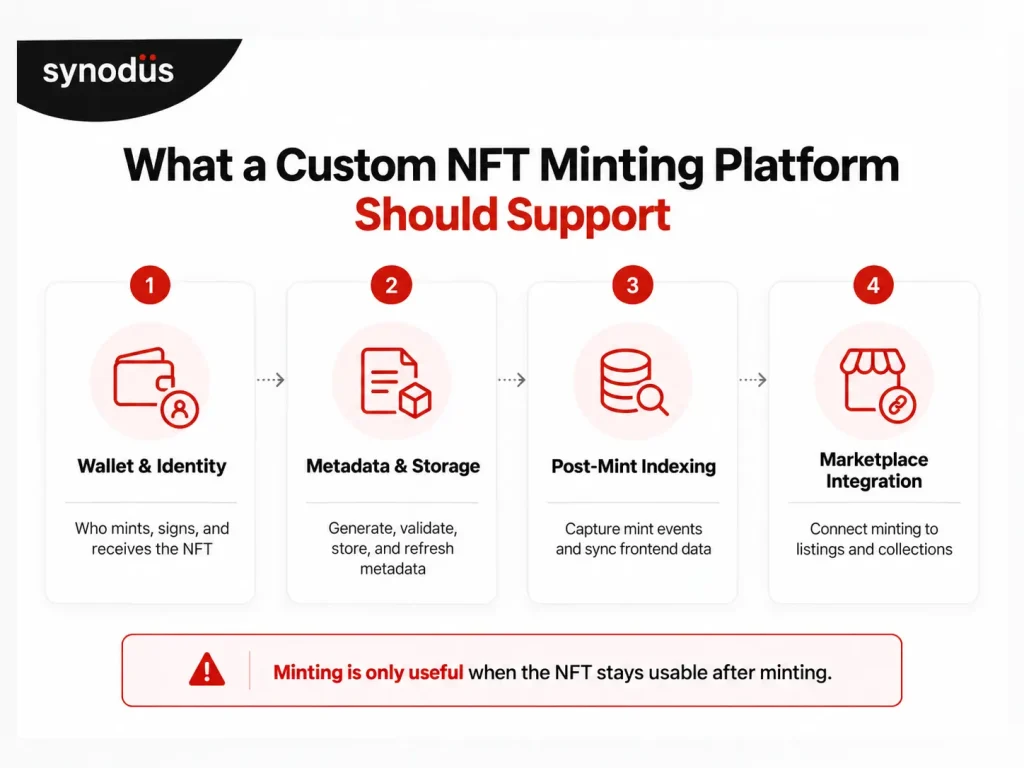
A custom NFT minting platform needs to connect the minting process to the rest of the product, not just execute a smart contract function. Wallets, metadata, indexing, and marketplace workflows all need to work together so an NFT remains usable after it is minted.
Wallet and identity
The platform needs a reliable way to identify who is minting, authorize the transaction, and determine who receives the token. Depending on the audience, this may involve standard wallet connections, embedded wallets, or role-based access. Consumer products may benefit from hiding much of the blockchain complexity, while enterprise or permissioned marketplaces typically need stronger identity and authorization controls.
Metadata and storage
The platform needs a clear approach to generating, validating, storing, and retrieving metadata, along with a way to refresh it when NFT traits change after minting, as with dynamic NFTs. The contract standard and minting method chosen earlier still matter here, but the key is applying those rules consistently across the platform rather than handling each NFT as a separate case.
Post-mint indexing
Reliable event processing is needed to capture every mint, link it to the correct metadata, and reflect it in the product without delays or mismatches. A mint that succeeds on-chain but does not appear correctly in the frontend is still a broken product experience.
Marketplace integration
The minting flow should connect naturally to listing and collection management, allowing users to mint and trade without leaving the product. For teams building the broader marketplace rather than only the minting layer, these requirements become part of a larger marketplace architecture, as covered in our guide to building an NFT marketplace.
Conclusion
NFT minting is the process of creating a unique token on a blockchain and assigning it to a specific wallet or address. The basic process involves choosing a blockchain, preparing the asset and metadata, connecting a wallet, completing the mint transaction, and verifying the resulting NFT.
The cost and complexity depend on factors such as the blockchain, gas fees, minting method, and scale of issuance. For a single NFT or simple collection, an existing minting platform may be enough. Projects with specific requirements may instead use lazy or batch minting, or build a custom solution for greater control over the minting process.