100,000 data points every second. 500 potential beds. Less than 2 seconds to respond. That was the scale behind a Smart ICU project for Vietnam’s leading national pediatric hospital.
The problem was that monitors, ventilators, infusion pumps, and other devices operated separately, creating a fragmented view of each patient.
Synodus had to bring those signals together, connect multiple device manufacturers and hospital systems, and turn them into information clinicians could act on. And we had 3 weeks to build the first working system. This is how we did it.
Project goal: Build a centralized, real-time Smart ICU platform that standardizes multi-vendor device data, reduces alarm fatigue, and integrates with the hospital’s core EMR systems.
About our client
Our client is a leading national pediatric hospital in Vietnam. They serve as the country’s top-tier referral center for complex and severe childhood cases.
The initiative started at the hospital’s Cardiovascular ICU, with the broader platform designed to support monitoring across up to 500 beds.
To deliver real impact, the system needed to ingest high-frequency data from multi-vendor hardware while integrating two-way with the hospital’s core infrastructure (HIS, EMR, LIS, PACS) under strict on-premise data requirements identified under Decree 13/2023/NĐ-CP.
For a system like this, our client needed 2 things above all:
- Fast: data must appear almost instantly.
- Reliable: the system must stay available around the clock.
| Industry | Healthcare |
| Country | Vietnam |
| Service | Software Delivery (Website development, Mobile app development, Data engineering) |
Business context & challenges
Prior to our engagement, bedside monitoring in the Cardiovascular ICU was spread across many separate devices. Medical staff had to check heart monitors, ventilators, and infusion pumps one by one. Each device came from a different manufacturer and used its own protocol, making it difficult to bring the data together.
This created severe operational bottlenecks and high-stakes clinical risks:
- Too many alarms: Different machines generated alerts independently, creating a constant stream of notifications. With so much noise, it became harder for medical staff to spot the alerts that really needed attention.
- Too much manual work: Nurses had to check patient data from individual machines and record it manually. This took time away from patient care and increased the risk of errors in time-sensitive records.
- High data volume: At peak load, the system needed to handle 8,000 simultaneous data streams and around 100,000 time-series data points per second, while keeping latency below 2 seconds. The existing setup was not designed to handle this volume.
The central challenge was not simply collecting more data. It was turning a continuous stream of fragmented signals into timely, clinically useful information without adding more alarm noise.
Project workflow
To handle the problems above, the project followed a strategic, 3-phase delivery model designed to validate high-risk real-time capabilities early, before moving into live clinical testing and hospital-wide expansion.
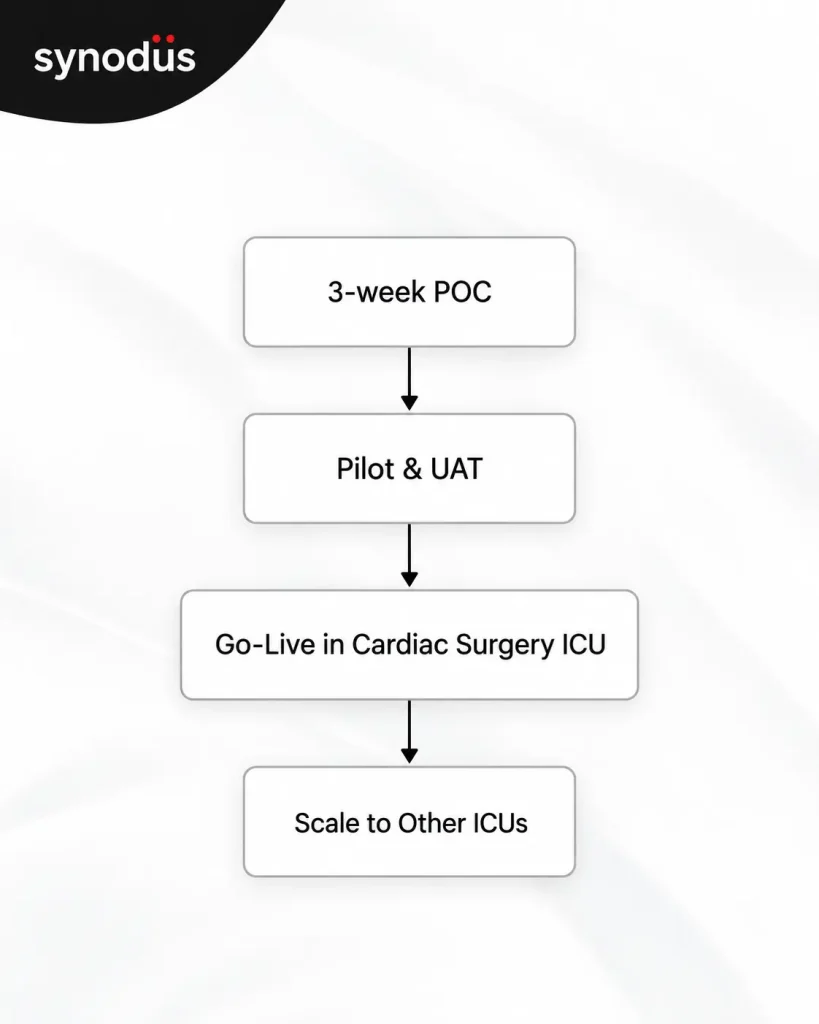
| Phase | Timeframe | Scope |
|---|---|---|
| Phase 1: AI-First Rapid POC | 3 Weeks | Write SRS, build prototypes, generate core backend code using Claude AI, and deliver a working POC to earn hospital leadership approval (Approval Gate 1) |
| Phase 2: Live Testing & UAT | September 2026 | Deploy to Dev/Demo environment, connect real medical device streams, and conduct clinical UAT at the Cardiovascular ICU (Approval Gate 2) |
| Phase 3: Go-Live & Scaling | Next Phase | Launch live operations alongside the EMR in the Cardiovascular ICU, then scale across all remaining critical care units |
The first phase demonstrated the technical feasibility of the core platform in a working POC. The second phase moved the system into live testing and clinical UAT, where the hospital could assess its real-world behavior before go-live.
Solution
We designed a centralized, real-time Smart ICU platform.
To meet the three-week POC timeline, we used a 100% AI-First software engineering framework built on an On-Premise Microservices Architecture because it allowed us to split the system into independent services, process thousands of device signals in parallel, scale high-load components separately, and keep the system responsive even at 100,000 data points per second.
Here’s how it works:
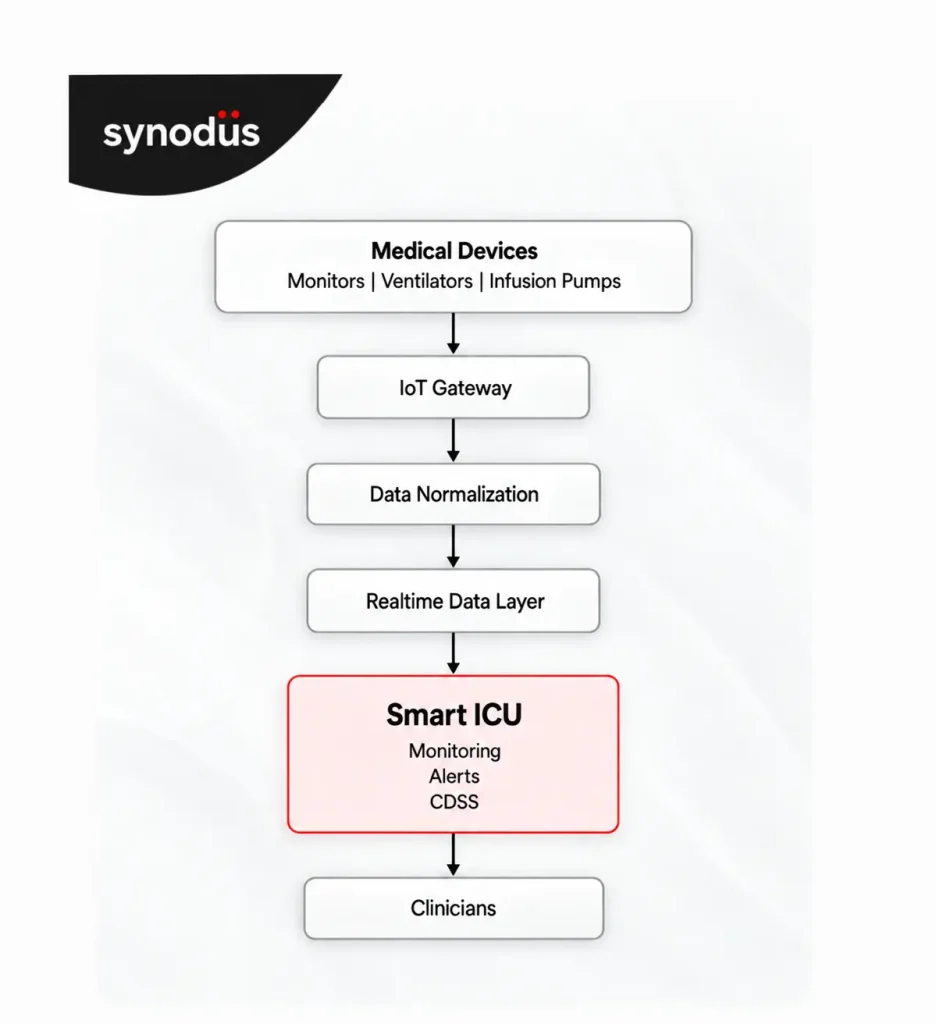
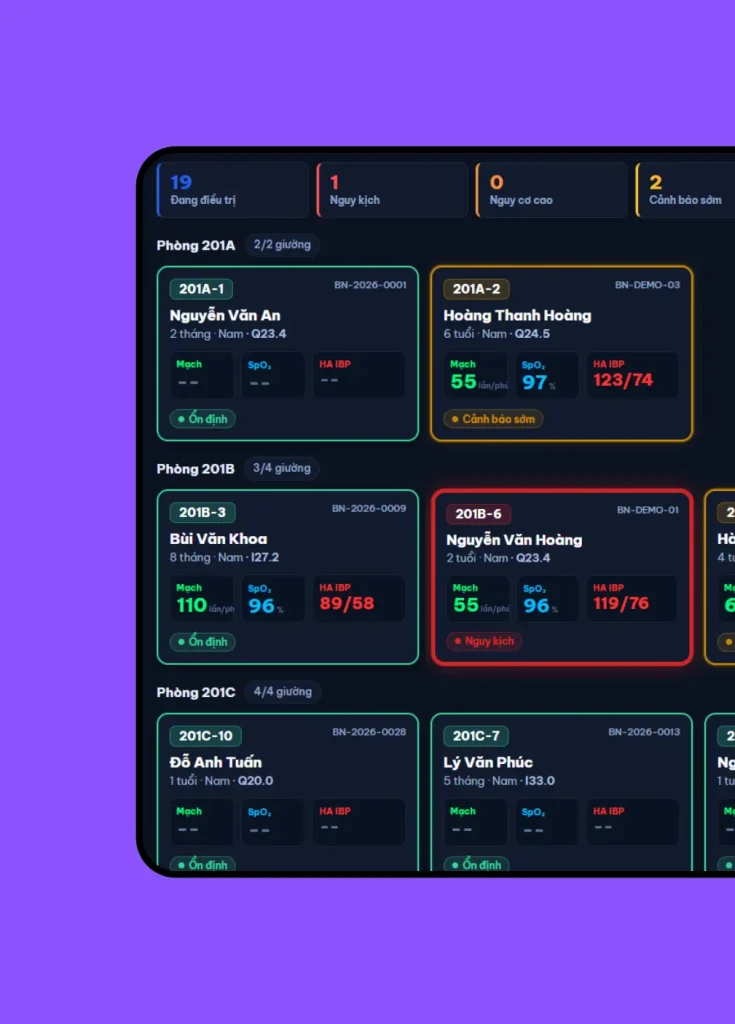
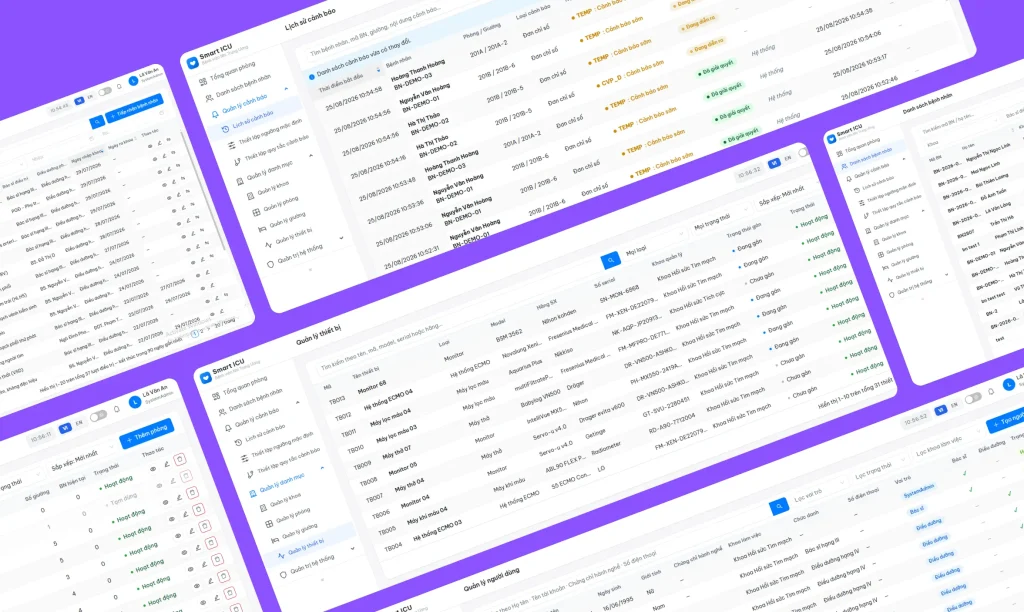
This solution focuses on 3 core capabilities. The IoT Gateway connects medical devices and converts their data into a common format, so everything can flow into one system. From there, realtime monitoring gives clinicians a single dashboard to track up the potential beds, instead of checking each device separately. On top of this, the Clinical Decision Support System (CDSS) calculates Early Warning Scores and flags signs of patient deterioration, helping clinicians focus on the alerts that need their attention most.
Process
Building a medical system of this scale in such a short time came with several challenges. The team had to deal with different medical device protocols, large amounts of real-time data, strict data requirements, and a delivery model without a traditional development team.
1. Turning BAs and QCs into module owners (the AI-first model)
The most radical management decision was the team structure itself. Led by Project Manager Tuấn Anh, Synodus deployed a lean 5-person team with no dedicated traditional developers.
Instead, Business Analysts (BAs) and Quality Control (QC) specialists took full ownership of individual modules end-to-end, from drafting SRS requirements and building prototypes to guiding Claude AI to generate production code. By establishing strict prompt-engineering pipelines and rigorous manual code-review gates, the team achieved 85% to 90% first-pass accuracy for AI-generated code and delivered a fully functional POC in just 21 days.
2. Taming multi-vendor protocols and extreme data scale
At peak capacity, the system had to process 100,000 data points per second across 8,000 active streams from diverse bedside device manufacturers, each running closed, proprietary data protocols.
To overcome protocol lock-in and database bottlenecks:
- We engineered the Medical IoT Gateway to normalize all incoming raw device feeds into standardized HL7 v2 and FHIR R4 formats before hitting the core database.
- We coupled RabbitMQ for event queuing with TimescaleDB (on PostgreSQL 14). This time-series setup isolated continuous vital data writes from query operations, maintaining sub-2-second streaming latency to central ReactJS dashboards and mobile Flutter apps via SignalR.
3. The on-premise infrastructure trade-off
When evaluating cloud deployment against on-premise infrastructure, the team faced a tough trade-off: public cloud offers easier auto-scaling, but medical data compliance (Decree 13/2023/NĐ-CP) and low-latency requirements ruled it out.
We made the firm engineering decision to deploy a Kubernetes (K8s) and Docker cluster fully on-premise inside the hospital’s data center. To handle changing clinical requirements on the fly during testing, BAs quickly adjusted SRS specs and prototypes, leveraging Claude AI to regenerate microservices within hours rather than weeks.
4. Human-in-the-Loop Clinical validation
To ensure the automated Early Warning Score (EWS) algorithm didn’t introduce dangerous false positives, Synodus implemented a strict feedback loop during initial clinical trials at the Cardiovascular ICU.
Liaising directly with department leadership and ICU doctors, the team fine-tuned the Clinical Decision Support System (CDSS) threshold logic based on real-world patient responses, ensuring the system suppressed routine background noise while reliably capturing true clinical decline.
Outcomes
The platform we built brought data from separate devices into one real-time system, making patient monitoring faster and easier for clinical teams.
| Area | Before | After |
|---|---|---|
| Patient data | Data was spread across different devices and systems. | Device data is brought into one real-time view. |
| Alerts | Multiple devices created too many separate alerts. | EWS is designed to highlight important changes and help reduce unnecessary alert noise. |
| Monitoring | Staff had to check devices and record data manually. | Vital data is streamed to central dashboards in under 2 seconds. |
| Delivery | A system of this scale would normally take much longer to build. | A working POC was delivered in just 3 weeks. |
And the numbers show just how much the platform was able to handle:
- 100,000 data points/second across 8,000 active streams
- Under 2 seconds for real-time data streaming
- 85–90% first-pass accuracy for AI-generated code
- 21 days to deliver the working POC
- 500 beds supported in the planned system
The hospital team also saw the value of the platform after the first working POC:
Synodus delivered a fully functional real-time ICU engine in 3 weeks, a timeline we thought impossible for software of this complexity. The system’s ability to eliminate false alarm noise while unifying multi-vendor devices gives our clinical teams the exact foresight needed in critical pediatric care.
Department Leadership, Vietnam National Pediatric Hospital
What’s next
The success of the 3-week POC marks the beginning of a broader digital transformation journey across the hospital’s critical care ecosystem.
Our client and us have outlined a phased roadmap to expand the system’s footprint, deepen its predictive capabilities, and establish a national benchmark for pediatric digital health.
The team will first move into clinical UAT, followed by EMR integration and go-live in the Cardiac Surgery ICU. From there, the platform can be expanded to other ICUs across the hospital’s 500-bed capacity.
Over time, the CDSS can also move beyond Early Warning Scores to more advanced predictive models, helping doctors spot signs of deterioration earlier.
If you’re looking to build a real-time healthcare system that can handle complex data and workflows, reach out to us.