Exchange vs wallet: the founder’s comparison
| Feature | Crypto exchange | Crypto wallet |
|---|---|---|
| Initial capital | – White label: $250,000 to $800,000 – Custom build: $300,000 to $800,000 mid-tier, $1 million-plus enterprise | – Basic MVP: $15,000 to $55,000 – Multi-chain mid-tier: $50,000 to $180,000 – Enterprise custody: $150,000 to $500,000-plus |
| Time to market | – White label: 2 to 6 weeks – Custom build: 6 to 18 months | – MVP: 3 to 5 months – Enterprise-grade: 7 to 14 months |
| Legal burden | KYC/AML, VASP or MSB licensing, MiCA in the EU. Compliance is usually the critical path, not the code | Generally lighter, but depends heavily on custodial vs non-custodial design |
| Core engineering focus | Matching engine, liquidity integration, custody security. Backend typically consumes 30 to 40 percent of the budget | Key management (MPC or hardware-backed), blockchain integration, UX. Backend and blockchain integration typically consume 40 to 50 percent of the budget |
| Revenue model | Trading fees, listing fees, margin and derivatives services | Premium features, partnership fees |
| Primary operating risk | Centralized custody of customer funds, making the platform a high-value hack target | Loss of user keys. On non-custodial wallets, this risk shifts to the end user |
| Liquidity requirement | Mandatory from day one, usually through market maker partnerships | Not applicable |
These figures come from Synodus’s own crypto exchange and crypto wallet development cost analyses, not a fixed quote. Actual cost depends heavily on scope, jurisdiction, feature complexity, and which development approach you choose. Treat any single number, especially the low end, as a starting point for a conversation, not a final budget.
What actually drives the cost and timeline
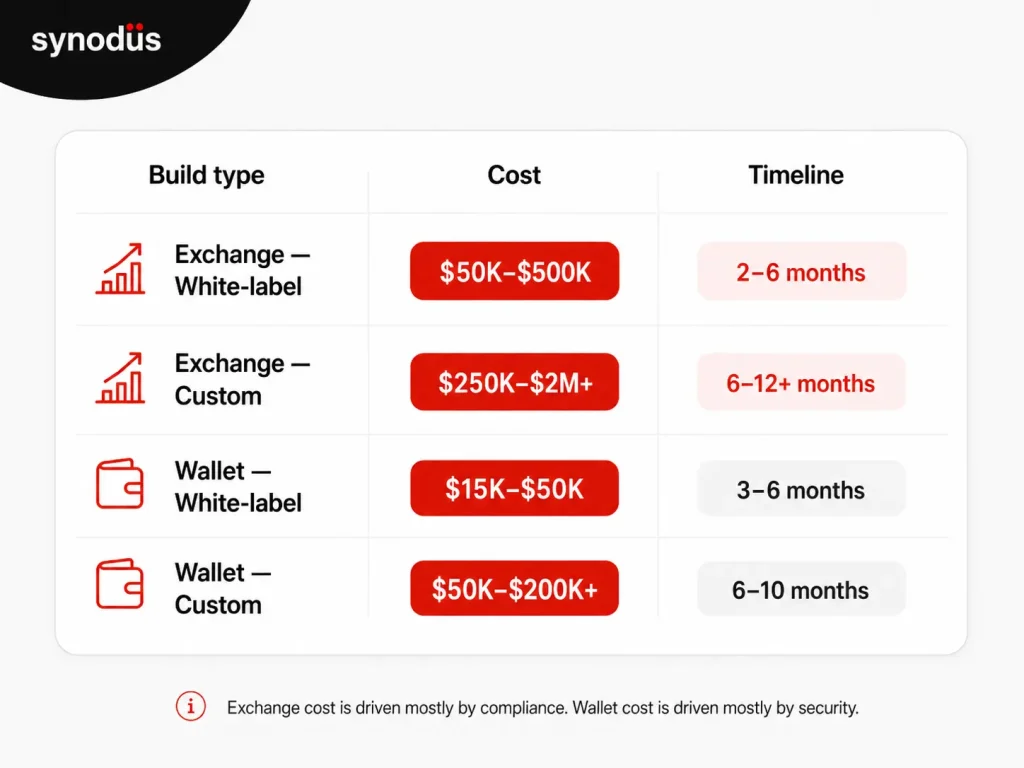
Exchanges are expensive mainly because of compliance, not code. A custom-built exchange runs $250,000 to $2 million-plus and takes 6 to 12-plus months, largely because licensing, not engineering, tends to stretch the timeline. This is why white label has become the default route for most startups: it cuts both cost ($50,000 to $500,000) and time to market (2 to 6 months) by licensing a proven trading engine instead of building one. The tradeoff is control: less flexibility over architecture, and in most cases, you still need to secure your own regulatory license separately.
Wallets follow the same pattern at a smaller scale. A white label wallet costs $15,000 to $50,000 and takes 3 to 6 months. A custom build runs $50,000 to $200,000-plus and takes 6 to 10 months, with security audits and key-management architecture, not feature count, usually driving the difference.
One caution worth flagging directly: some vendors advertise open-source or bare-bones clone scripts for as little as $5,000. That figure sits well below even Synodus’s white label range and almost always describes a product not ready to compete for user trust or survive a security review. Budget from the ranges above, not the lowest number you find.
Legal and compliance load by model
Exchanges carry the heavier compliance load. Depending on your target market, you are looking at KYC/AML obligations, a Money Services Business or Virtual Asset Service Provider registration, and, if you serve EU users, authorization as a Crypto-Asset Service Provider under MiCA, the EU’s regulator, ESMA. These requirements typically run in parallel with development, and licensing is frequently the actual bottleneck to launch, not engineering capacity.
Wallets carry a lighter but still real burden, and the split matters: a custodial wallet, where you hold user funds or keys on their behalf, inherits much of the same regulatory exposure as an exchange. A non-custodial wallet, where users control their own keys, shifts both the security responsibility and most of the regulatory weight onto the user. This distinction is one founders underestimate most often when scoping a wallet product.
When exchange and wallet overlap: the hybrid model
A growing share of new products no longer fit cleanly into either category. Exchanges are increasingly shipping embedded, non-custodial wallets as a retention feature, so users can hold assets without leaving the platform. At the same time, self-custodial and decentralized wallets are enabling exchange-like functionality, letting users trade directly from a wallet they control, without ever handing custody to a centralized operator. If you are scoping a new product in 2026, it is worth deciding early whether you actually need a pure-play exchange or wallet, or whether a hybrid model better fits how your users will actually behave.
Crypto exchange vs wallet: which fits your use cases
The right answer changes depending on what you are actually building. A generic exchange-vs-wallet checklist misses that.
| Use case | Best-fit model | Why |
|---|---|---|
| DeFi startup | Non-custodial wallet, or a DEX-style exchange | Your users expect self-custody by default. A DEX model also avoids much of the centralized-exchange licensing burden. |
| Fintech or neobank adding crypto | Custodial wallet | You likely already carry a licensed financial entity, so a wallet extends existing compliance infrastructure rather than requiring a new one. |
| Payment app adding crypto rails | Embedded custodial wallet | The job is moving money, not trading it. Market-making and order-book infrastructure are unnecessary overhead. |
| Web3 game or NFT platform | Non-custodial wallet, often with social-login onboarding | Players need low-friction onboarding, and holding player funds directly creates custodial liability a gaming company is rarely set up to carry. |
| Real-world asset tokenization platform | Hybrid: a marketplace layer plus custodial or semi-custodial wallet | Trading tokenized assets needs order-book or marketplace functionality, but investor assets still need secure, often regulated, custody. |
Mistakes founders make choosing exchange vs wallet
Most founders do not get the exchange-vs-wallet decision wrong on the big question. They get it wrong on the assumptions underneath it.
Underestimating compliance costs and timeline
Licensing gets treated as a formality to handle after the product is built, when in practice it is usually the longest item on the critical path. Budget and schedule for it in parallel with development, not after.
Choosing a custody model that does not match the business
Custodial wallets feel easier to control, so founders default to them without registering that custodial design inherits much of the same regulatory burden as running an exchange. The custody decision should follow from your compliance capacity, not from a UX preference.
Expecting a cheap clone script to be launch-ready
A $5,000 open-source script can get a demo running, but it typically skips the security audits and custody architecture a real product needs. It rarely survives investor or partner due diligence, and re-architecting later costs more than building it right the first time.
Treating security audits as a one-time checkbox
An audit before launch is necessary but not sufficient. Custody architecture, smart contracts, and key management need ongoing review as the product evolves, not a single pre-launch sign-off.
Ignoring liquidity requirements until after the exchange is built
For an exchange, a market maker relationship is a day-one requirement, not something to line up after development wraps. Founders who treat it as a launch-week task usually delay their own go-live.
Which should you build: a crypto exchange or a wallet?
Build an exchange if:
- You already have, or can realistically secure, a market maker or liquidity partnership before launch
- Your team can absorb licensing and compliance work as a parallel workstream, not an afterthought
- Your revenue model depends on trading volume rather than asset accumulation
See our step-by-step guide on how to create a crypto exchange for the technical build process.
Build a wallet if:
- Your core value proposition is security and user control, not trading
- You are comfortable with a non-custodial design, which reduces your compliance surface but requires excellent key-management UX to avoid user error
- You are building wallet functionality as an extension of a broader product, rather than as the sole business
See our guide on how to create a crypto wallet for the technical build process.
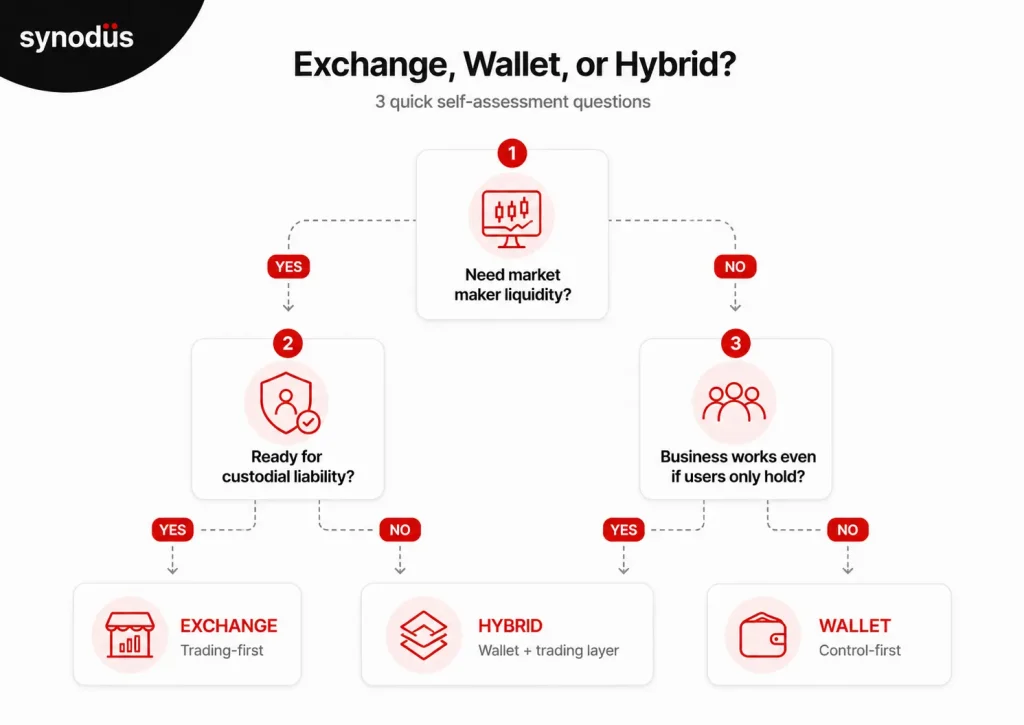
If you are still unsure, three questions usually clarify it fast: Do you need to hold a market maker relationship before you can generate revenue? Are you prepared to carry custodial liability for user funds? Is your business viable if users only ever hold assets and never trade on your platform? Your answers point to one model more clearly than any feature list will.
How Synodus can help
With over 7 years of experience in blockchain development, Synodus has built both exchange and wallet infrastructure for startups entering this space.
White label exchange, five months to market. A blockchain startup partnered with Synodus to launch a white label decentralized exchange, aiming to enter the market quickly amid rising DeFi demand. The main constraints were a tight five-month timeline, regulatory complexity, and limited in-house engineering capacity. Synodus delivered a customizable white label solution built around the client’s brand, with multi-signature wallet security and regular audits protecting user assets, and an architecture designed to scale as user volume grew. The result was a 150 percent increase in user engagement within the five-month window.
See our blockchain portfolio for more examples of exchange and wallet products we have built.
Get a free architecture review. Book a free 30-minute call with our blockchain team and walk away with: a recommended architecture (white label vs custom, custodial vs non-custodial), a realistic budget range for your specific scope, and a list of which compliance requirements actually apply to your target market.
Conclusion
The exchange versus wallet decision comes down to three questions: how much capital and time you can commit, how much regulatory exposure your team can carry, and where your revenue actually comes from. Get those three right, and the rest of the build follows a much clearer path.
FAQs
An exchange runs $50,000 (white label) to $2 million-plus (custom, enterprise). A wallet is cheaper: $15,000 for a white label build up to $200,000-plus for a full custom solution.
Depends on custody. Custodial wallets face licensing similar to exchanges. Non-custodial wallets carry a lighter burden, though this still varies by jurisdiction.
Non-custodial shifts key-management risk to the user and lowers your compliance exposure, but demands stronger UX. Custodial gives you more control but makes you liable for user funds.