This article examines average blockchain developer salaries across major regions and explores how these differences influence project budgeting, team composition, and delivery models. Understanding these dynamics helps organizations move beyond surface-level cost comparisons when evaluating blockchain development partners.
By analyzing salaries as a core cost factor, this perspective bridges the gap between raw compensation data and strategic vendor selection decisions.
Blockchain developer salary as a core project cost factor
Blockchain developer salaries are one of the most influential cost components in blockchain projects. Regardless of project scope or technology stack, labor costs typically account for 40–60% of total development expenses, making salary levels a primary driver of overall project budgeting.
Unlike infrastructure or tooling costs, developer salaries scale directly with:
- Team size
- Experience level (junior, mid, senior)
- Project duration
As a result, even small differences in salary levels can lead to significant variations in total project cost.
Impact on hourly rates
Developer salaries directly determine the hourly or daily rates charged by blockchain development vendors. Higher salary markets usually translate into higher billing rates, as companies must account for:
- Compensation
- Talent retention
- Operational overhead
In contrast, regions with lower average salaries allow vendors to offer more competitive hourly rates while maintaining sustainable team structures. This dynamic explains why the same blockchain solution can be priced very differently depending on where the development team is based.
Influence on pricing and engagement models
Salary levels also shape how blockchain projects are structured commercially. In higher-cost markets, vendors often favor:
- Fixed-scope or tightly defined projects
- Shorter engagement periods
- Senior-heavy teams focused on architecture and critical components
In more cost-efficient markets, salary flexibility enables:
- Retainer-based models
- Longer-term development partnerships
- Mixed team compositions combining junior and senior developers
These differences affect not only pricing, but also delivery pace, iteration cycles, and long-term maintainability.
Effect on outsourcing and offshore decisions
One of the primary reasons companies explore outsourcing blockchain development or offshore development is salary disparity between regions. Lower salary environments make it possible to:
- Reduce total project cost
- Allocate budget toward extended development or additional features
- Scale teams more easily as project requirements evolve
However, salary should not be viewed in isolation. Effective vendor selection requires balancing cost efficiency with factors such as technical expertise, communication, and delivery reliability.
By understanding blockchain developer salaries as a core project cost factor, businesses gain a clearer framework for estimating budgets, comparing vendors across regions, and making informed outsourcing decisions.
Average blockchain developer salaries by region
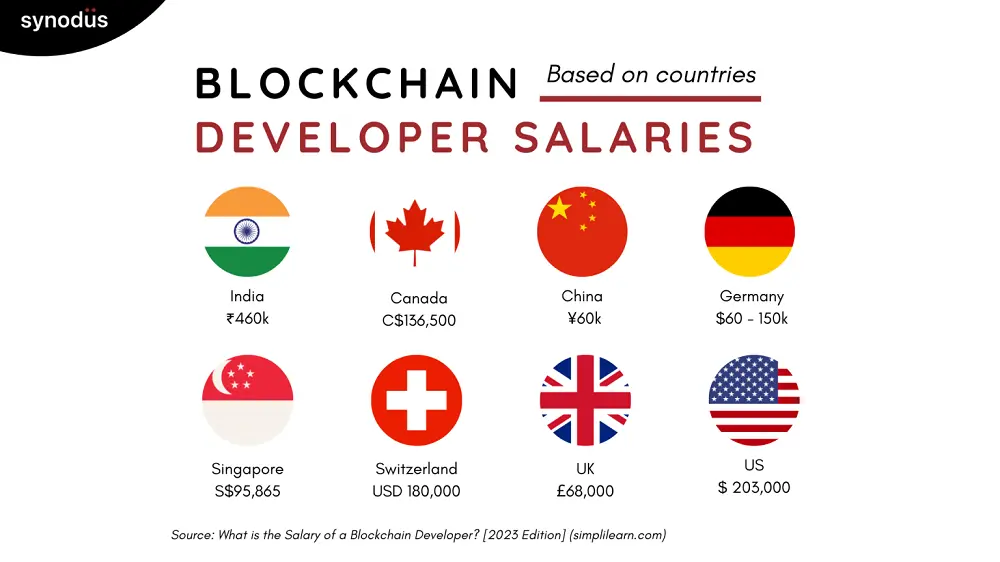
Blockchain developer salaries differ widely across regions due to variations in cost of living, talent supply, market maturity, and demand for blockchain expertise. Rather than indicating quality alone, these differences primarily reflect economic and market conditions in each region.
The figures below represent approximate annual salary ranges for blockchain developers and are intended to provide context for cost comparison, not precise benchmarks.
The salary ranges below reflect aggregated estimates from global technology workforce reports and outsourcing benchmarks, including insights from Deloitte, PwC, Accelerance, Clutch, and Web3 industry data sources.
| Region | Average annual salary (USD) | Cost level | Market characteristics |
|---|---|---|---|
| United States | 100,000 – 160,000 | Very high | Mature market, strong enterprise demand |
| Singapore | 80,000 – 130,000 | Very high | Financial hub, compliance-driven projects |
| Western Europe | 60,000 – 110,000 | High | Regulated markets, stable talent base |
| Canada | 70,000 – 120,000 | High | Skill workforce, competitive costs vs US |
| Eastern Europe | 35,000 – 70,000 | Medium | Strong engineering tradition, outsourcing-friendly |
| Vietnam | 20,000 – 45,000 | Medium | Rapidly growing talent pool, cost-efficient |
| India | 15,000 – 35,000 | Low | Large talent supply, highly cost-effetive |
Blockchain developer salaries by experience level
In the blockchain and Web3 job market, compensation tends to rise with experience — and this dynamic shapes how development companies price their services. Vendors rarely staff teams exclusively with senior engineers; instead, they balance labor cost and capability by combining junior, mid-level, and senior roles, which directly influences project budgets and vendor competitiveness.
Across global salary benchmarks for blockchain and Web3 developers, typical annual ranges in 2025 reflect this progression:
- Junior / Entry Level (0–2 years): Approximately $80,000 – $120,000 annually, a range seen in industry salary reports for developers just starting with smart contracts and decentralized apps. (Source)
- Mid-Level (2–5 years): Around $120,000 – $160,000 per year, representing engineers taking on independent development tasks and growing responsibility. (Source)
- Senior (5+ years): Typically $160,000 – $200,000+, with highly experienced engineers, protocol specialists, and team leads often earning at the upper end or above, especially in enterprise or DeFi roles. (Source)
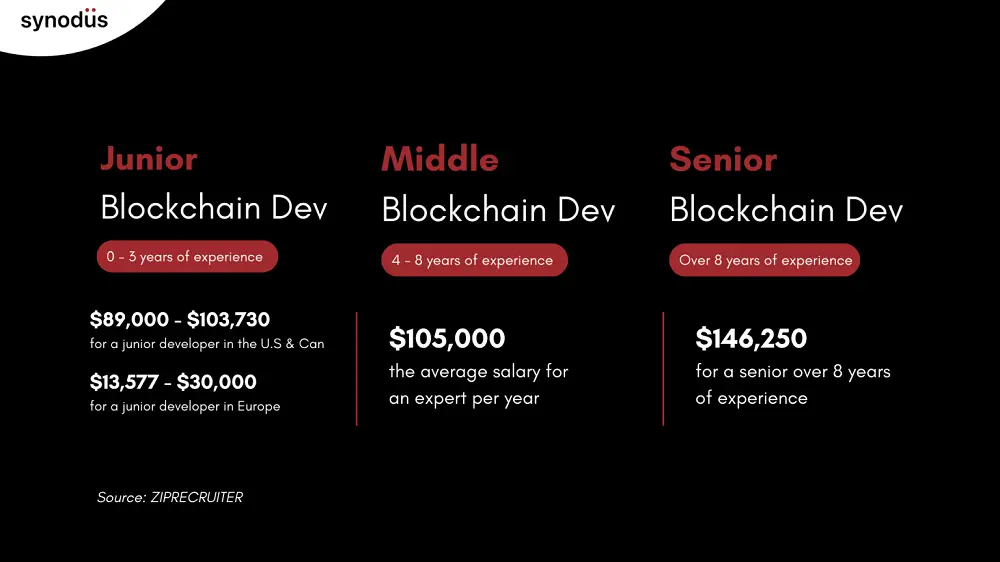
These figures are derived from aggregated salary data across multiple blockchain salary sources, reflecting base compensation before bonuses, token incentives, or equity that many Web3 roles also offer.
In practice, blockchain development companies factor this experience-based compensation mix into their vendor pricing: junior and mid-level engineers help keep overall costs competitive, while senior engineers focus on architecture, security, and strategic decision-making. Understanding these relative salary ranges helps buyers interpret vendor proposals and compare how different teams are structured in terms of cost and capability.
How salaries influence blockchain company competiveness
Developer salaries do not merely reflect compensation levels – they fundamentally shape how blockchain development companies operate, compete, and position themselves in the global market. From team structure to client focus, salary economics influence nearly every aspect of a blockchain vendor’s competitiveness.
1. Talent depth and specialization
Higher salary environments typically allow companies to attract and retain developers with deeper specialization – such as protocol engineering, zero-knowledge proofs, or enterprise blockchain architecture. This often translates into stronger internal R&D capabilities and the ability to handle complex, long-term initiatives.
Conversely, regions with more moderate salary levels tend to emphasize scalable talent pools, where companies invest in training, standardized development processes, and faster onboarding. While individual specialization may vary, teams are often optimized for execution efficiency and adaptability across multiple projects.
2. Delivery models and pricing flexibility
Salary levels directly influence how blockchain companies structure their delivery and pricing models.
In higher-cost regions, vendors often operate on:
- Premium hourly rates
- Dedicated teams with longer engagement cycles
- Retainer-based or outcome-driven contracts
These models are typically aligned with enterprise clients seeking reliability, governance, and long-term partnership.
In more cost-efficient regions, companies can offer:
- Flexible engagement models
- Competitive hourly or project-based pricing
- Easier scalability for growing or experimental projects
This pricing flexibility makes such vendors particularly attractive to startups, scale-ups, and innovation-driven teams.
3. Operational efficiency and scalability
Salary economics also affect internal operations. When labor costs are high, blockchain companies tend to prioritize:
- Automation and tooling
- Lean team structures
- Strict project scope control
In lower-cost environments, companies often focus on:
- Team scalability
- Parallel development streams
- Faster iteration cycles
Neither approach is inherently superior; rather, each reflects a different optimization strategy shaped by local talent costs.
4. Client focus and market positioning
Over time, salary structures influence the types of clients blockchain companies serve.
- High-salary regions often align with regulated industries, enterprise adoption, and large-scale transformation initiatives.
- More cost-efficient regions are commonly positioned toward startups, Web3-native products, and rapid prototyping needs.
This natural segmentation explains why blockchain development companies across regions tend to develop distinct reputations and strengths – even when technical capabilities overlap.
5. Strategic impliactions for vendor selection
For organizations evaluating blockchain development partners, understanding salary-driven competitiveness is critical. Developer compensation affects not only cost but also:
- Project velocity
- Risk tolerance
- Communication models
- Long-term sustainability of the vendor relationship
Rather than viewing salary differences purely as a pricing factor, decision-makers benefit from considering how these economics shape a company’s operating model and strategic priorities.
Conclusion
Blockchain developer salaries play a central role in shaping how development companies compete and how vendors are selected globally. Salary levels influence cost structures, delivery models, and the types of projects companies are best positioned to handle.
Rather than viewing salary as a standalone metric, organizations should consider it alongside technical maturity, collaboration practices, and long-term delivery capabilities. Different regions naturally compete on different strengths, and understanding these dynamics helps align vendor selection with real project needs.
There is no single “best” region for blockchain development – only the best fit based on context, priorities, and growth stage.