TL;DR
- Buying AI tools is not a complete strategy. AI solves the typing problem, but if a team lacks strict rules, AI simply generates bad code faster.
- Software engineers do not just type syntax anymore. Their job is to give the AI the right business context, audit the machine’s output, and take full responsibility for the final quality.
- At Synodus, we do not measure success by how fast developers feel. We measure it by how safe, reliable, and cost-effective the software is in the real world.
- Our engineering excellence contains 4 pillars: outcome ownership, predictability, continuous hardening, enterprise-safe.
The core challenge and the new role of the engineer
Today, companies face a very hard problem. They need to adopt new AI technology to stay competitive, but they also have to keep their old, critical systems running perfectly. And thay must do both without spending more money.
Many business leader think buying AI coding tools will solve this problem completely.
For a long time, building software was a slow, step-by-step process. Engineers spent most of their time translating business needs into technical plans, typing repeated code, setting up databases, and testing features by hand. Productivity was simply measured by how much code a person could write.
Today, AI has changed every single stage of the software process. It acts as a highly capable assistant. A simple prompt now serves as a direct design rule. AI can quickly plan the early structure of a project. When you describe what data you have, AI can generate the initial setup for your database. It writes the basic code in seconds. It scans for basic errors, suggests ways to save server costs, and auto-generates the text that explains how the code works. It saves hours of manual labor.
But there is a trap here. AI only solves the typing problem.
AI works fast by calculating what code is most likely correct. However, it does not know your exact business rules. It does not understand the history of your company or the heavy security needs of a banking system. It can easily make errors or create code that works today but breaks tomorrow.
Therefore, every single line of AI-generated code must be treated as a first draft.
If a company just gives AI tools to a team that lacks strict rules, they do not get innovation. They just get more bugs, much faster. Speed without control leads to a messy, broken system.
This reality completely changes the role of the modern software engineer. The job is no longer about typing code syntax from memory. The job is to lead and manage intelligent systems.
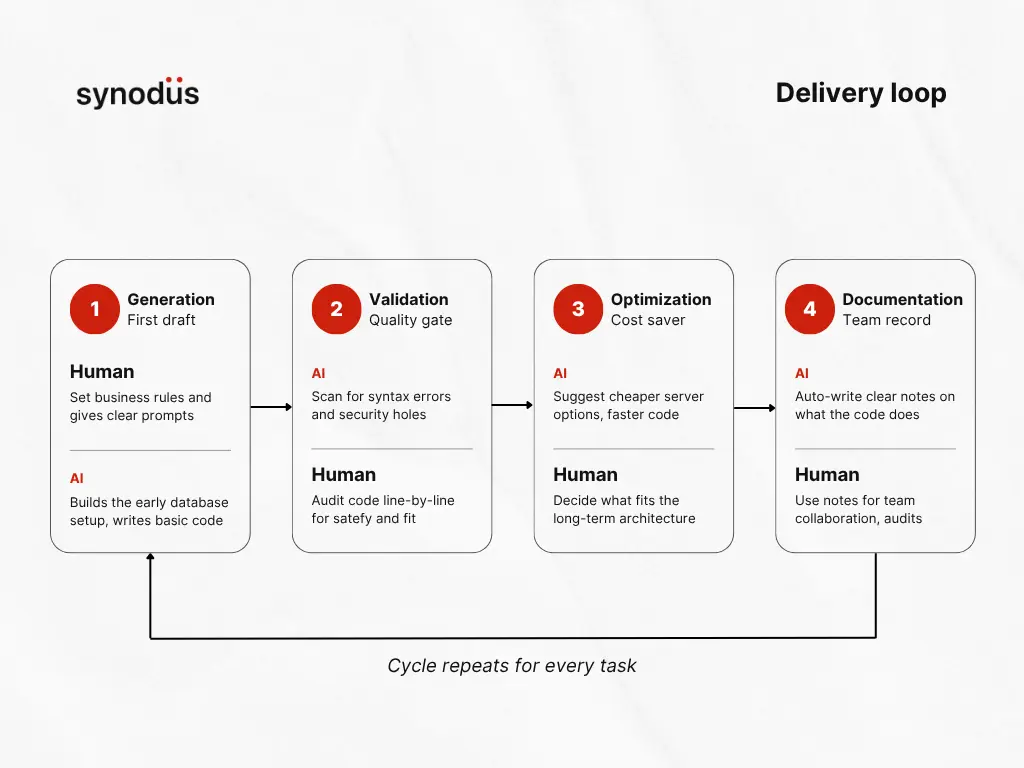
Since AI has the power to generate so much code so fast, the responsibility of the human engineer has actually increased. To build with AI means you must audit everything. The human engineer must review the code line by line. They must reorganize the AI’s output so the internal structure is clean and easy to maintain. They must run strict tests to find hidden errors and secure the system against threats.
The machine generates the code, but the human forces the quality.
Because the job has changed, how we measure success must change too. In the past, companies measured how fast developers could write. Recently, they measured “Developer Experience” – how happy and efficient their teams felt.
Today, that is no longer enough.
We must measure how well the technology actually drives real business results, reduces costs, and improves safety. The new standard must prove that the final software is completely reliable.
This shift in how we build, check, and measure software is what we call Engineering Excellence.
A label means nothing without proof
We hear the words “engineering excellence” a lot today. Many tech companies use them to describe a fast team or a good-looking website. But a label means nothing without proof.
At Synodus, engineering excellence is proven inside mission-critical environments.
If a system handles banking data, healthcare records, or government operations, the software cannot fail. In these high-stress situations, we cannot just rely on the speed of AI. We have to rely on a complete standard of excellence. We divide this standard into two clear parts: the personal level and the organizational level.
At personal level: the responsible engineer
What does excellence mean for a single engineer? It means an engineer does not just finish a coding task and walk away.
Writing the code is only the first step. True excellence means the person actively looks for risks before they become real problems. If an error happens, they do not just apply a quick patch. They find the exact root cause of the problem and fix it permanently.
Most importantly, our engineers stay with the product even after it goes live to real users. They take the time to ensure the software passes the hardest security checks. They run heavy load tests to make sure the system will not crash when thousands of users log in at the same time. The human engineer takes full ownership of the final result.
At organizational level: the system for success
However, great engineers cannot win if the company system slows them down.
At the organizational level, engineering excellence means building a workplace that lets engineers do their best work. We remove heavy management layers. We cut out useless handover steps where information gets lost between teams.
Instead, we give our teams structured AI tools and strict enterprise security rules. This combination is very important. IT gives our teams the power to upgrade old, complex systems quickly, without breaking the parts of the business that already work perfectly.
When you combine responsible engineers with a clear, fast system, you get reliable software. To make sure this happens every single time, Synodus builds our entire delivery process on four strict pillars.
How we keep AI safe in mission-critical systems
To ensure our systems never fail in mission-critical environments, Synodus builds our AI-driven delivery process on four strict pillars.
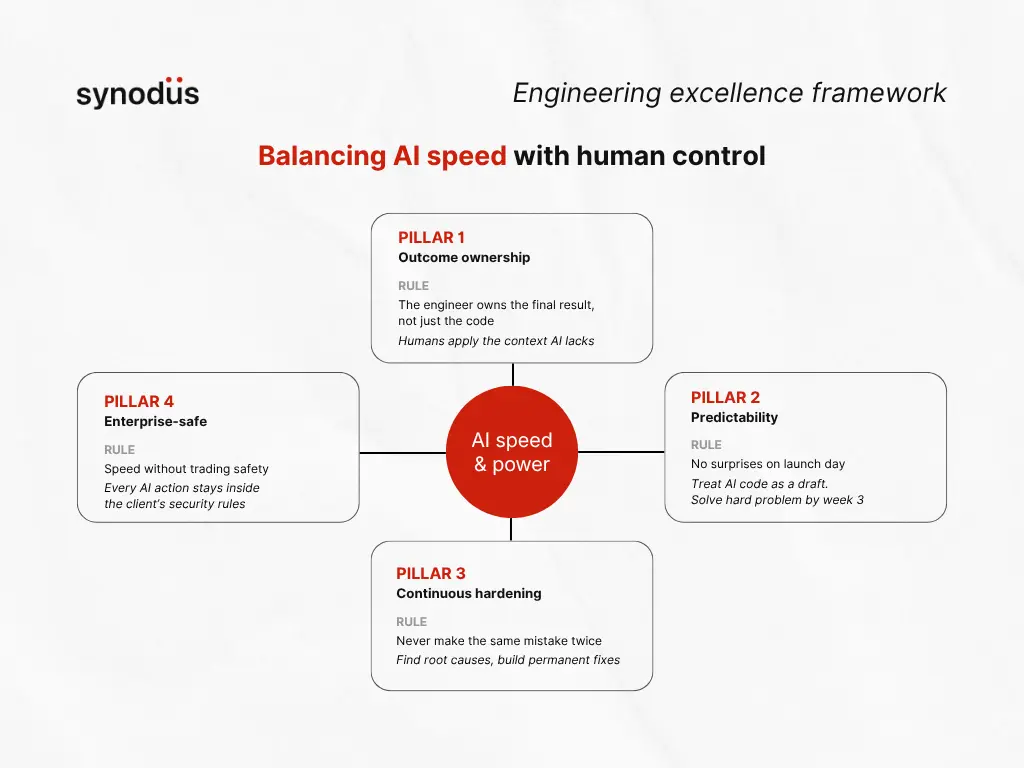
Pillar 1: Outcome ownership (stay liable)
At Synodus, the engineer who takes the job is the person who owns the final result. If something breaks, we do not pass the blame to another department.
In the age of AI, this personal responsibility is more important than ever. Today, knowing the business context is just as important as knowing the code. AI knows how to write software, but it does not know your business rules. It does not know what your users want. It does not know how your systems connect.
Our engineers do. Because our engineers hold this vital business knowledge, they work as a direct part of the client’s team. Their job is not just to operate AI tools. Their job is to ensure the AI output actually solves the real business problem.
Pillar 2: Predictability (No surprises on launch day)
Excellence is not just fixing problems fast. Excellence is seeing problems before they happen.
For companies to adopt AI, they must trust it completely. If we cannot trust the machine’s output, we cannot use it. We know that AI can make mistakes or write insecure code. Therefore, we treat every single line of AI-generated code as a rough draft.
To create predictability, we build strict review steps and clear backup plans to undo changes if things go wrong. If a project has deep technical risks, our engineers tell the client the hard truth in week three of the project. We solve the hard problems early. We never wait to find out on launch day.
Pillar 3: Continuous hardening (No repeat failures)
Errors will happen in software delivery. But a strong system must learn from its mistakes. At Synodus, we have a strict rule: the exact same failure must never happen twice.
When a bug appears, our team stops. They find the exact root cause of the error and build a permanent fix. Today, many companies only measure how fast they can release software. At Synodus, we measure how safe the code is over time.
This strict discipline is how we take fast, early AI drafts and turn them into highly secure, professional-grade software that large businesses can rely on.
Pillar 4: AI-native and enterprise-safe (Speed without trading safety)
We use AI to do routine tasks. This saves our teams a massive amount of time. Because our engineers do not have to type basic code, they have more time to design better, smarter systems.
We put AI into the whole software building process, from the first database design to the final code checks. However, we force every AI action to stay strictly inside the security rules of our clients.
This setup allows the business to move fast and try new things, without ever putting their private data or legal rules at risk. We give our clients the speed of AI, but we never trade away their safety.
The bottom line: redesigning how we work
The first wave of AI was simple. It was just about helping individual developers type code faster. But the next wave is much bigger. It is transforming the entire process of how software is built.
Many people worry that AI will replace the need for software engineers. The truth is exactly the opposite. AI does not replace great engineers. It actually makes great engineers more important than ever before.
A machine can write thousands of lines of code in a minute. But a machine does not know your customers. It does not know your long-term business goals. It does not care if your system fails.
Only a human cares. Only a human can take full responsibility for the final result.
Today, any company can buy AI tools. Giving your team an AI assistant is no longer a special advantage. As AI continues to change how we build software, the companies that win will be the ones that invest in how they lead.
Engineering excellence is not a trend. It is a strict discipline.
The real advantage belongs to organizations that redesign how their teams work. The winners will combine the incredible speed of AI with clear ownership, deep business knowledge, and a strong system to support safe growth.
At Synodus, this is exactly how we deliver software. We do not just build fast. We build with control, with safety, and with a guarantee of quality.
That is what true Engineering Excellence means in the age of AI.