AI is helping engineering teams develop software faster, reduce manual effort, and solve increasingly complex problems. But the same technology is also helping cybercriminals discover vulnerabilities, automate attacks, and target more organizations with fewer resources. As enterprises accelerate AI adoption, an important question deserves more attention: are enterprise security practices evolving at the same pace?
In this episode of The Performance-led AI Log series, Quan Nguyen, Vice Director at Synodus, examines the changing cybersecurity landscape, draws lessons from a recent security incident within Synodus’s engineering environment, and explores what enterprises can do to reduce their exposure.
About Quan Nguyen
Quan Nguyen is Vice Director at Synodus, with over a decade of experience in software engineering and technology delivery. He began his career as an Android developer in 2015, gaining hands-on experience in mobile application development and AI engineering before working as a Senior Android Developer in both Vietnam and Japan.
Since joining Synodus in 2021, Quan has progressed through technical leadership, project management, and department management. His professional focus spans enterprise software delivery, engineering quality, technical risk management, and the integration of AI into the software development lifecycle. With a background in Computer Science from Vietnam National University, Hanoi, he approaches technology adoption from both an engineering and an operational perspective.
How AI is changing the cybersecurity landscape
Recent security incidents illustrate the different ways AI is reshaping cybersecurity.
On October 29, 2026, Cursor disclosed a supply chain security incident involving maliciously modified versions of the Claude Code extension distributed through its marketplace. On November 4, India’s Computer Emergency Response Team (CERT-In) issued a critical advisory concerning AI-assisted cyberattacks targeting financial institutions. Later that month, European Union officials confirmed an AI-enabled cyberattack against a key EU institution, with some digital services still unavailable at the time of disclosure.
These incidents are different in nature. Some involve attackers using AI to support their operations, while others involve compromised tools within the AI ecosystem. Together, they illustrate how the security challenges facing enterprises are changing.
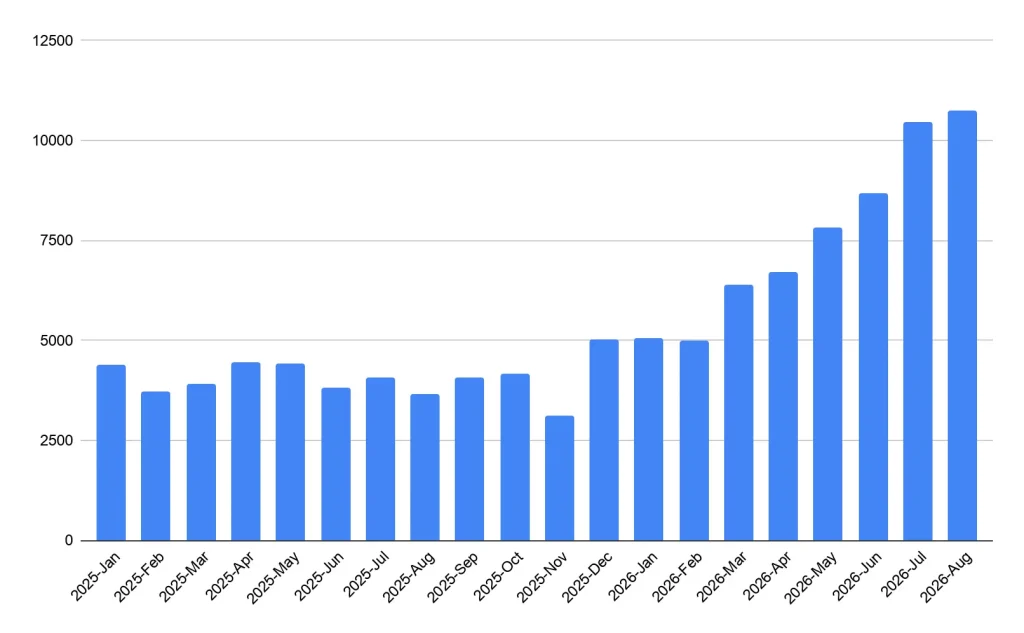
Research from Google Threat Intelligence Group provides further context. Between January and August 2026, the monthly number of disclosed vulnerabilities more than doubled, rising from 5,045 to 10,740. Actual exploitation is also increasing. The average number of vulnerabilities exploited in the wild rose from 10.5 per month in 2025 to 18 per month between January and August 2026, an increase of approximately 71%. While not every disclosed vulnerability is exploited, and AI is not the sole driver of this growth, these trends highlight a growing challenge for enterprises: security teams must assess, prioritize, and address an increasing volume of vulnerabilities while attackers gain more efficient ways to exploit them.
Cyberattacks existed long before generative AI. Attackers were already using automated scanners, stolen credentials, malware, and social engineering. What AI changes is the speed, cost, and scale of these activities.
There are three developments that engineering leaders should pay particular attention to:
- Faster vulnerability discovery: AI can analyze large amounts of technical information and assist in identifying weaknesses with less manual effort.
- Greater scale: Attackers can investigate more potential targets simultaneously, making opportunistic attacks easier to carry out.
- A growing attack surface: Coding assistants, AI agents, third-party extensions, and external integrations introduce additional components and permissions that organizations need to secure.
An organization does not need to be a major bank or a global technology company to become a target. Attackers can search broadly for weaknesses before deciding which organizations are worth pursuing.
A recent security incident at Synodus demonstrates why this matters.
An attack that started on an engineer’s computer
One of our developers responsible for system monitoring has installed a Claude-branded extension in their development environment. An internal investigation found that the extension contained malware, which gave an attacker unauthorized remote access to the developer’s computer. The attacker then attempted to gain access to an administrative account on one of the systems.
The concerning part was that these requests originated from Synodus’s internal network. Security configurations often treat internal traffic differently from external traffic. However, when a device inside the network is compromised, its location is no longer a reliable indicator of whether its activity is legitimate.
The monitoring system detected an unusual volume of requests overnight and alerted the administrators. The engineering team investigated, identified the affected device, and isolated it from the network to prevent further access.
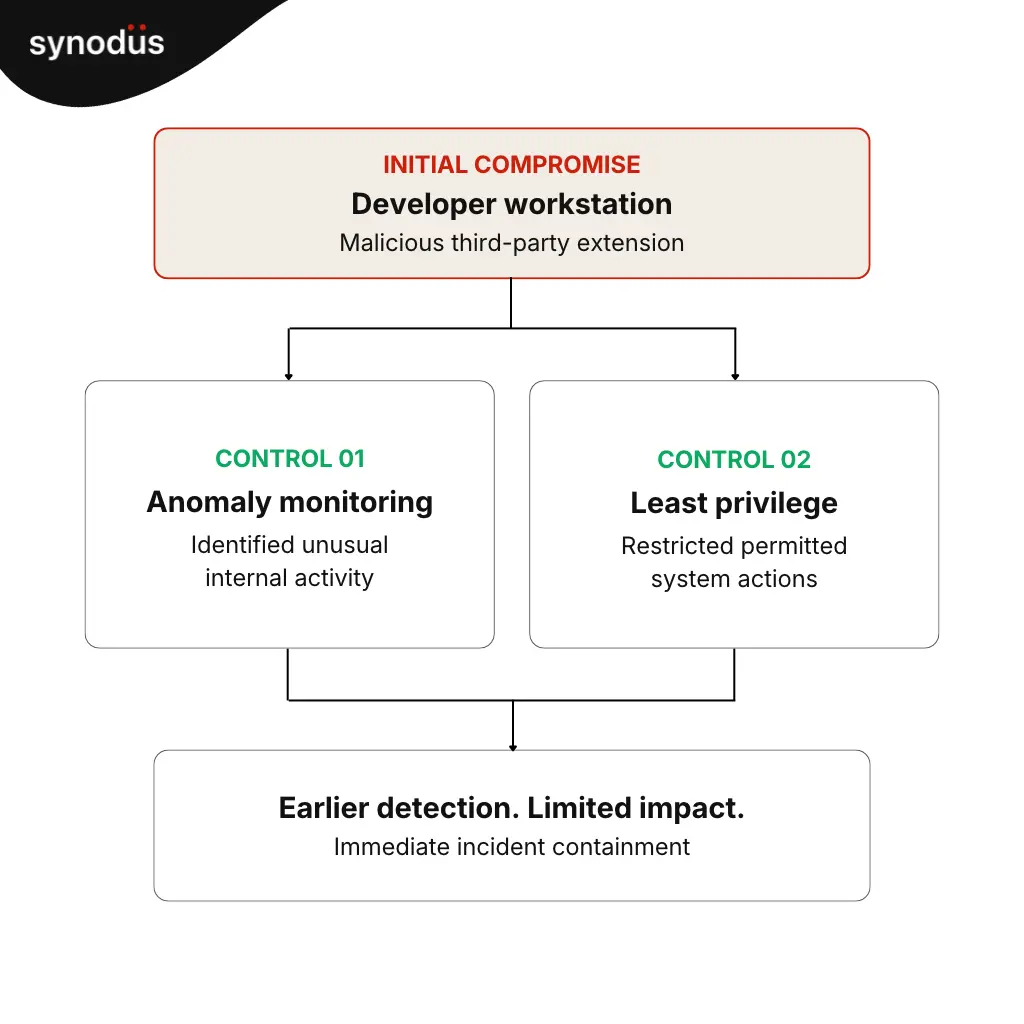
Two existing security controls were particularly important in containing the immediate incident.
- The first was anomaly monitoring: The monitoring system identified unusual behavior even though the requests came from within the company network. Without this visibility, the suspicious activity could have continued unnoticed.
- The second was the principle of least privilege: The developer’s account had view-only access, which was sufficient for the assigned monitoring responsibilities. The account had no permission to modify the system. If broader access had been granted for convenience, the potential consequences would have been considerably greater.
Read-only access does not eliminate security risk, particularly when sensitive information is involved. However, restricting permissions reduces the number of actions an attacker can perform through a compromised account.
Neither control prevented the initial compromise. One helped detect it, while the other limited its potential impact.
This distinction is important. An effective security architecture must account for the possibility that one of its defenses will eventually fail.
The security boundary extends beyond the application
Traditionally, much of the attention in software security has been placed on application code, infrastructure, databases, and network protection. These remain essential, but they are only part of the picture.
Consider the environment in which modern software engineers work. Developers install extensions, use open-source libraries, connect AI assistants to repositories, and integrate external tools into their daily workflows. Depending on their configuration, these tools may have access to source code, credentials, local files, and internal services.
Every additional tool introduces another component that the organization needs to trust.
The recent Cursor incident also illustrates why downloading software from a recognized marketplace is not always sufficient. The distribution channel itself can be compromised.
As enterprises adopt AI-driven software development, engineering leaders need to understand what tools are being used, what information those tools can access, and what actions they are permitted to perform. Security reviews should cover the entire engineering environment, not just the application that eventually reaches production.
The objective is not to restrict innovation. It is to allow teams to experiment with new technology without introducing unnecessary access to critical systems.
Five security practices engineering teams should strengthen
Most of the security principles needed to address these challenges already exist. The problem is often how consistently they are applied.
Drawing on the lessons from Synodus’s recent incident and the broader changes in the cybersecurity landscape, five areas deserve particular attention.
Practice 1: Manage development tools as part of the software supply chain
Maintain an inventory of approved coding assistants, IDE extensions, third-party dependencies, and AI integrations. Verify software publishers and distribution sources, review permissions, and monitor security advisories. Popularity and positive reviews are useful signals, but they are not substitutes for security assessment.
Practice 2: Apply least privilege to people, services, and AI agents
Access should be determined by what a role needs to accomplish. A developer responsible for monitoring does not necessarily need administrative access. The same principle applies to an AI agent that reads documentation or assists with code generation. Permissions should be reviewed regularly, especially when responsibilities change or temporary access is no longer required.
Practice 3: Monitor behavior, including activity inside the network
Teams should have an incident response process that covers device isolation, evidence preservation, assessment of affected systems, session revocation, and rotation of potentially exposed passwords, SSH keys, and API tokens. Removing a malicious extension alone does not establish that an affected device is safe to use again.
Practice 5: Build security awareness into engineering operations
Developers need to understand the risks associated with unfamiliar tools, but training alone is insufficient. Organizations should provide approved alternatives, safe environments for experimentation, and clear procedures for reporting suspicious activity. A security process should remain effective even when someone makes a mistake.
These practices involve additional engineering effort. Evaluating tools takes time. Access restrictions require management. Monitoring and incident response need dedicated resources. However, these costs should be considered alongside the operational risks they help reduce.
Security should be part of engineering performance
At Synodus, the AI-driven software delivery framework focuses on improving development efficiency while maintaining the engineering controls required for enterprise systems. Security needs to be part of that same approach.
When evaluating AI adoption, organizations often focus on development cost, delivery speed, and time-to-market. However, these indicators alone cannot provide a complete picture of engineering performance. Enterprises also need to understand how effectively their teams manage security exposure and respond when something goes wrong.
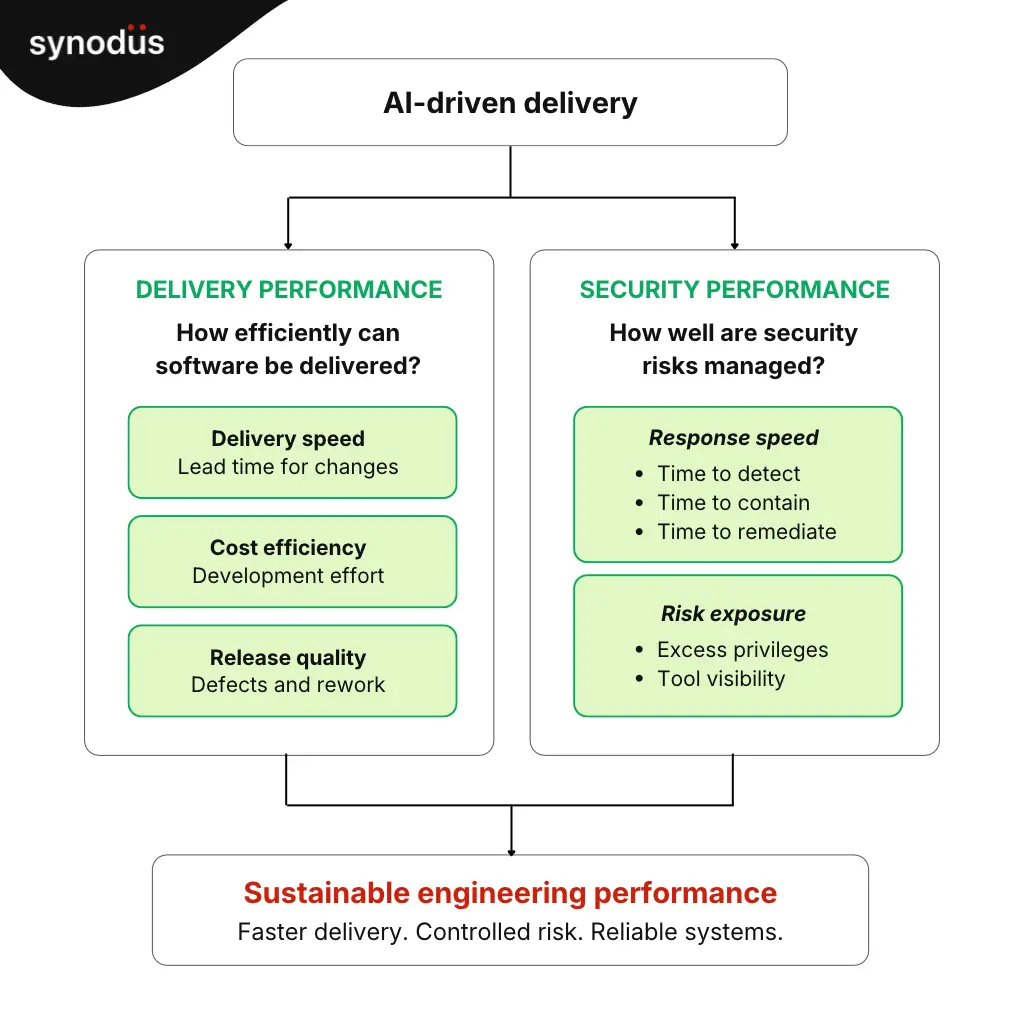
Engineering leaders should consider measuring:
- Detection time: How long does suspicious activity remain unnoticed?
- Containment time: How quickly can a confirmed threat be isolated?
- Remediation time: How quickly are critical vulnerabilities addressed?
- Privilege exposure: How many accounts have unnecessary permissions?
- Tool visibility: Does the organization know which development tools and AI integrations have access to its engineering environment?
The first three indicators measure how quickly an organization can identify and address security problems. The remaining two help assess its existing exposure. Together, they offer a more complete view of security readiness.
If development becomes faster but the organization loses visibility over its tools, permissions, and infrastructure, the productivity improvement comes with additional risk.
For enterprises operating critical systems in banking, healthcare, government, or other regulated environments, this balance is particularly important. A security incident can affect not only development schedules but also business continuity, sensitive information, and the people who depend on those systems.
AI will continue to change how software is built and how vulnerabilities are discovered. Engineering teams cannot guarantee that every attack will be prevented. They can, however, improve their ability to detect threats, limit their impact, and recover from incidents.
The fundamentals of cybersecurity have not disappeared in the age of AI. They need to be applied more consistently, with faster detection and response.
That is what sustainable engineering performance requires.