How the project started
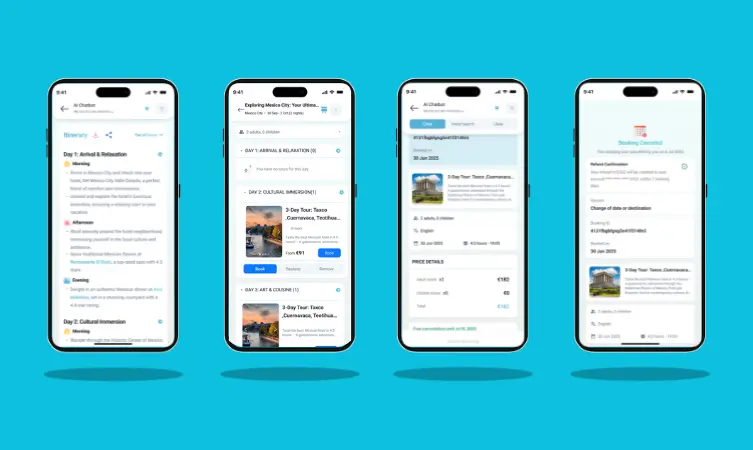
In 2025, we teamed up with a client who had a bold, almost risky vision. They wanted to kill the search bar. In the world of travel, we’ve all grown used to the online traveler agent things which make you open twenty tabs, adjust a dozen filters for price and rating, and spend hours planning for a trip.
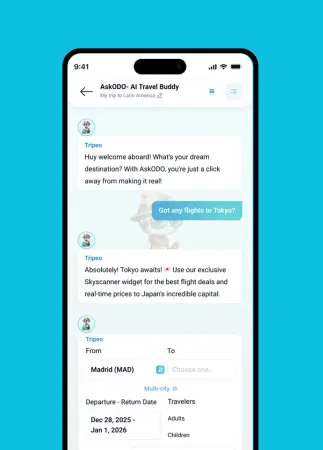
Tripeo’s goal was to replace that entire manual process with a single, natural conversation called AI Travel Buddy.
They reached out to Synodus to make that vision a reality. As an engineering team, we knew this was more than just a product build. It was a total UX Paradigm Shift, and our job was to teach a machine to think like a local tour guide.
The real challenges we had to jump over
When we started, we realized that building an “AI Buddy” is much harder than it looks on paper. We ran into three big walls:
1. The one-screen challenges
Usually, travel apps are full of buttons, tabs, and menus. We decided to throw all of that away and use just one chat screen. It was a huge risk. We spent weeks building prototypes and breaking them, trying to find a way to make a chat box feel powerful but simple. We didn’t want users to feel lost on a blank screen, so we had to test and fail many times until the conversation felt as easy as texting a friend.
2. Teaching the AI to actually “Think”
We realized that making AI smart enough to be a travel agent is the hardest part. In the beginning, the AI was too generic. We had to spend a lot of time fine-tuning the logic so it could understand the “why” behind a user’s request. If you asked for a “quiet hotel,” the AI had to be smart enough to avoid spots near busy nightlife. It took a lot of work to make the suggestions feel human and accurate.
3. Working under Microscope
Our client was extremely detailed about every single move the AI made. We had to be incredibly disciplined, checking every line of logic and every small behavior of the product. We worked long hours to make sure our code met the client’s high standards and that everything worked exactly as promised.
How we engineered the conversation
With all of the challenges, we decided to build an intelligent system through a process of Iterative Product Engineering. This can be described as the 3 following solutions:
1. The AI engine (backend deep dive)
We built a custom engine using NodeJS that acts as the “brain.” When a user types a request, the engine parses the intent, filters through vast travel data, and structures it into a complete itinerary (Stay, Dining, Spots) in seconds.
2. The “sweet spot” discovery
Using a fast-cycle Agile methodology, we tested different AI algorithms every two weeks. test different AI algorithms and UX flows rapidly to find the “sweet spot” for user engagement. This “test-and-fix” approach helped us find the perfect balance between AI creativity and data accuracy.
3. A unified experience
Using Flutter and ReactJS, we ensured that this version was a streamlined mobile and web interface where planning, discovery, and decision-making happen within a single conversation flow.
The outcome
After months of pushing the limits of AI to make it as smart as a real travel agent, we saw some results that meet our client’s requirements:
- Time efficiency: We cut down the average trip planning time by 50% to 70%.
- Foundation for scale: Our core AI architecture is stabilized and ready for transactional integration.
- Strong client trust: Our client was so impressed with how we solved the complex AI logic and kept our discipline that they approved Phase 2 immediately.
- Market ready: We delivered one of the first truly conversational travel apps, proving that the “One-Screen” model actually works for complex industries.
Keep going with Phase 2
Now we are already moving into Phase 2, where we’ll turn Tripeo into a full travel ecosystem.
Our main focus is on connecting everything together. We’re adding real-time flight and car rental bookings directly in the chat. Also building a smart route feature that automatically finds the best path between destinations, so travelers spend less time planning and more time exploring. We’re excited to keep pushing the boundaries of what a “Travel Buddy” can truly do.
If you have a complex challenge that needs a smart AI solution, we’re ready to help you solve it.
How useful was this post?
Click on a star to rate it!
Average rating / 5. Vote count:
No votes so far! Be the first to rate this post.