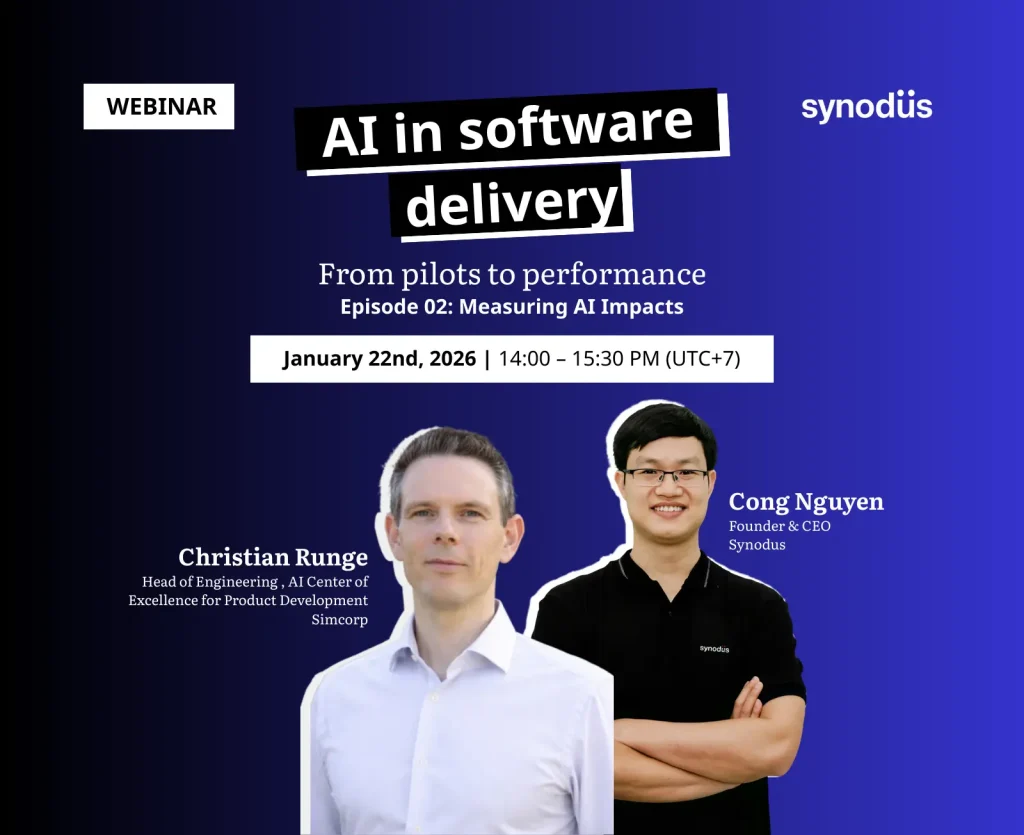
If Episode 1 focused on navigating the chaos of AI adoption, Episode 2 focuses on how to measure impact, protect code quality, and scale AI safely across both enterprise and mid-sized organizations.
Stream the full session
Click here to watch the full episode, see the live workflows and Q&A.
Brought to You by
Synodus is a software engineering company based in Vietnam, specializing in banking & finance, healthcare, and the public sector. We help organizations deliver mission-critical systems by combining strong domain understanding, disciplined delivery, and pragmatic AI adoption – focusing not just on building software faster, but on building the right software with confidence and trust.
Learn more about Synodus.
In this episode
Billions of dollars have been invested in GenAI. Why are 95% of organizations seeing zero returns?
In Episode 1, we defined the operating model for AI adoption. In Episode 2, we focus on defining and capturing its value.
Cong Nguyen (Founder & CEO, Synodus) opens the session with a critical look at the numbers. He introduces the “AI Paradox”: why teams with high AI adoption often experience decreased delivery stability, and why feeling productive does not always translate into shipping faster. This frames the central challenge – the gap between AI adoption and measurable business impact.
To address this gap, the episode explores two complementary approaches to measuring AI value from different organizational perspectives:
- Christian Runge (Senior Director, Engineering for AI & Insights, SimCorp) provides a large-enterprise perspective. He explains how an organization of 2,900 employees secured positive ROI with no initial budget, justified AI investment to the CFO, and built an internal AI platform (CodeMate) to protect intellectual property. His insights demonstrate how structured governance and enterprise-scale thinking enable AI to generate real financial impact.
- Cong Nguyen then presents a mid-sized, agile perspective. He shares how Synodus moved beyond individual productivity metrics to team-level measurement, tracking how AI reduced rework by 10-20%, and increased delivery throughput by 5-8%. This shows how smaller, flexible teams can capture value by integrating AI directly into everyday workflows.
Throughout the episode, the discussion also surfaces critical challenges that affect value creation, including the hidden risks of code churn (code written and then deleted) and the strategic “Build vs. Buy” decisions every engineering leader must confront in 2026.
Watch the full episode to see how leading teams define and measure AI value beyond speed, prevent AI-driven technical debt, and create workflows that keep humans in control while maximizing impact.
Interesting sections from the episode
1. The “AI Paradox”: Why faster coding often leads to slower delivery (starting at 03:11)
By Cong Nguyen
Cong opens with a clear reality check on the 2025 AI landscape. While many teams report feeling more productive, delivery data reveals a different outcome. A growing gap has emerged between perceived productivity and actual shipping results.
The Trap: While individual developers feel more productive, team-level data shows delivery stability drops by 7.2% in high-adoption teams.
Cong explains the root cause:
AI makes it easy to generate large blocks of code. This causes teams to violate the ‘small batch’ principle. We end up with a traffic jam in the testing and review phase. AI doesn’t fix the broken delivery process. It exposes weaknesses.
This section establishes the episode’s core insight: AI adoption alone does not guarantee delivery improvement.
2. Rolling out enterprise AI with “Zero Budget” (starting at 08:33)
By Christian Runge
Christian addresses a practical challenge many enterprises face: deploying AI to 1,500 developers while managing legacy systems, strict IP requirements, and no approved budget.
He explains how SimCorp deliberately prioritized simplicity and speed at the outset:
We had no budget. We had legacy add-ons. We had major IP questions. Our approach was simple: enable engineers first. We used manual license management via email and clear communication. We avoided heavy governance upfront. The result was 188 active users in the first month, with almost no friction.
This section demonstrates how reducing complexity can accelerate real adoption and momentum.
3. The ROI of AI adoption: Proving the financial value (starting at 35:00)
By Christian Runge
Christian walks through the exact logic SimCorp used to justify AI investment to the CFO.
We didn’t just guess. We tracked adoption and applied the European salary norm. We tracked a 3.5% – 4.9% reduction in total work time (not just coding time). By December, that calculation showed a net saving of €133,591 per month…Beyond the money, the ROI is talent retention. If we force engineers to work with old tools while the world moves forward, we lose our best people.
4. “Build vs. Buy”: When to build your own AI tools (starting at 31:04)
By Christian Runge
Why did SimCorp buy GitHub Copilot but build its own internal agent? Christian explains the decision framework:
Our principle is simple: buying commodities, building competitive advantages. Code completion is a commodity. The context is not. Standard AI doesn’t understand our databases or our proprietary APL language. CodeMate allows developers to interact with SimCorp’s infrastructure, not just the public internet.
5. The Synodus impact: 5-8% Throughput increase (starting at 44:45)
By Cong Nguyen
Cong shares performance metrics from a mid-sized engineering organization, contrasting the Pilot phase with the Performance phase:
After implementing strict quality gates and the ‘Two-Lane Model’ (from Ep 1), Synodus measured a 5-8% increase in delivery throughput and a 10–20% reduction in major rework. We stopped tracking hours saved and started tracking sprint capacity reclaimed. We also saw that 70-80% of engineers reported positive effectiveness, proving that the tool is helping, not hurting.
Timestamps
(00:00) Intro
(03:11) 2025 GenAI in Software Engineering: 95% Fail and 5% Succeed
(04:45) Christian Introduction
(07:45) AI in SimCorp
(08:33) Key Barriers at SimCorp: Budget, IP and Risk, Technical Landscape, Rollout
(11:50) SimCorp’s Approach: Manual Admin & Simplicity
(15:30) Synodus AI Adoption Journey: Context & Approach
(19:43) Key Barriers at Synodus (Non-technical): Constraints & Organizational Reality
(22:54) Early Signals in Product Design & Coding
(26:50) What AI Pilots Taught Us
(29:00) SimCorp: Organic Improvements in AI Adoption
(31:04) CodeMate: AI-Powered Window into SimCorp Infrastructure (ROI & Value)
(38:52) Looking Forward to 2026 (SimCorp): Ethics First, Project-Level Governance, AI Beyond Engineering
(43:40) Looking Forward to 2026 (Synodus): Performance-Led, Domain-Fit, AI-Native
(46:18) The Evolving AI Journey at SimCorp
(55:00) Conclusion: AI Adoption Is a Marathon, not a Race
(59:48) Q&A
References
Connect with the Speakers:
- Christian Runge: LinkedIn Profile
- Cong Nguyen: LinkedIn Profile
Resources mentioned:
- MIT Project NANDA 2025
- GitClear 2025 Report
- Forrester 2025
How useful was this post?
Click on a star to rate it!
Average rating / 5. Vote count:
No votes so far! Be the first to rate this post.